
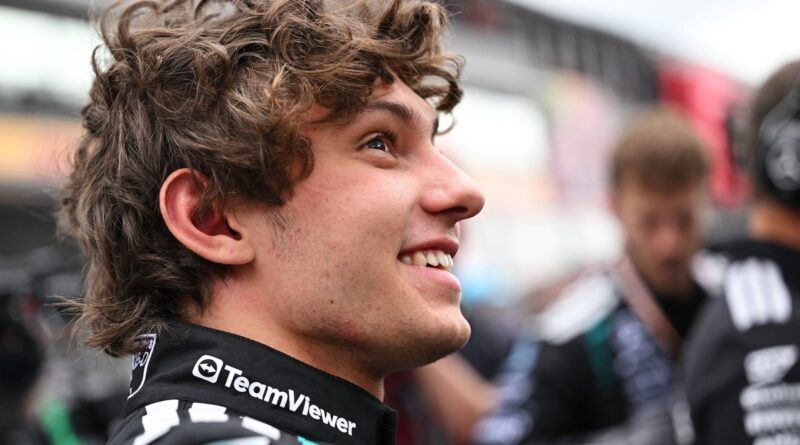
Maturity, experience, self-belief – The keys to Kimi Antonelli’s new F1 level
Mercedes deputy team principal Bradley Lord has given several reasons behind Kimi Antonelli’s rise into a Formula 1 title contender this season.
Antonelli endured a tough rookie campaign last year as F1’s third-youngest driver in history, having bypassed F3 to spend just one year in F2 before joining one of the most successful teams in the world championship – courtesy of Lewis Hamilton leaving Mercedes for Ferrari.
The Italian youngster used to be vastly outperformed by team-mate George Russell but has reversed that dynamic as F1 switched to new technical regulations – to the extent that he’s leading the 2026 drivers’ standings at the summer break, having won six out of 11 grands prix, including five in a row.
“I’ve been asked a few times if I’d been surprised,” Lord commented. “And I guess no and yes is the answer.

Bradley Lord, Deputy Team Principal, Mercedes AMG F1 Team
Photo by: Andy Hone/ LAT Images via Getty Images
“We signed Kimi and we took the decision to bring Kimi into the team because we believed in his potential. But it’s also undeniable to see a driver in just his second season in Formula 1 performing with so much consistency and with a real, calm maturity is incredibly impressive.
“Through that difficult first season, it’s almost like he managed to do multiple seasons’ worth of learning in one, and then that’s all consolidated over the winter.
“I’m sure there’s also to some extent the reset factor of new regulations, that means every driver is on a steep learning curve with new cars and new power units and that seems over the field to have seen a re-balancing between newer drivers in the sport and older drivers as well in the teams where you can see those pairings.
“Kimi’s obviously done and continues to do an incredible job, and you see his confidence and his self-confidence building from weekend to weekend, not in a way that he’s getting carried away with anything, his feet are very firmly on the ground and kept very firmly on the ground by his family and inside the team as well. You can just see his self-belief growing and that’s really, really impressive.”
Expanding on how Antonelli bounced back from that difficult 2025 season, Lord continued: “I think he found the method that worked for him in order to get the most from the team, understand the effort that is needed ahead of the weekend in order to arrive prepared – because track time is such a scarce and valuable commodity, particularly in a calendar where we’re seeing ever more sprint races, and therefore it’s an FP1 and then you’re straight into a timed session, a competitive session and such rather than a free practice session.

Kimi Antonelli, Peter Bonnington
Photo by: Reginald Mathalone / NurPhoto via Getty Images
“It was a really useful reset around Baku time for him to really redouble his efforts with Bono [race engineer Peter Bonnington] and the rest of the team around him, with the regularity of the visits to the sim and the intensity and depth of the work there, for him to see the opportunity that was there for him to grab and to take. And he’s taking it with both hands.”
What also contributed to this upturn was Mercedes’ approach to shelter Antonelli from pressure and media frenzy as much as possible, with lessons learned from a 2024 Monza FP1 outing where the very keen youngster crashed the F1 car on his first flying lap – he definitely wasn’t holding back.
“We’ve been very careful and very judicious with how we’ve tried to support Kimi’s introduction to Formula 1,” Lord added. “It’s a huge step for any driver, particularly with the expectation that comes with driving for Mercedes, and so helping him not be overworked and overloaded with marketing commitments or PR stuff at the track and other events but managing that in as smooth a way as possible.
“We often say to the drivers, ‘Look, we can’t make you faster with this stuff, but if we get it wrong we can definitely slow you down’.”
However, when it was suggested that a youthful Antonelli might have been ‘more adaptable’ than Russell to get the most of F1’s new machinery, Lord swiftly dismissed that view.
“No, I don’t think either of the drivers has been set in their ways or anything other than completely open-minded about how to get the best out of these cars,” he insisted. “The ability to adapt and to be agile and versatile is always a key strength of any top driver, and both Kimi and George have that ability and capability as well.

Andrea Kimi Antonelli, Mercedes, George Russell, Mercedes
Photo by: Steven Tee / LAT Images via Getty Images
“These are cars where – and this is a formula where you can get a little bit lost sometimes in some of the complexities of it – the input and the advice has been just to keep it simple, concentrate on the driving, getting the tyres in the right place, doing the bits that every racing driver always needs to do well and the systems, then do the learning they need to do and support and deliver in an optimal way as well.
“Obviously when things aren’t quite working right, that can get pretty complex and pretty complicated, but I think Kimi’s been able to strip away a lot of the noise actually and really focus on the essentials, focus on the core parts of what he needs to do, and then that creates the space for the engineers to focus on the set-up and the optimisation of all the other systems as well, so it’s been a really good balance of effort between those different things.”
Additional reporting by Oleg Karpov and Roberto Chinchero
We want your opinion!
What would you like to see on Motorsport.com?
– The Motorsport.com Team