
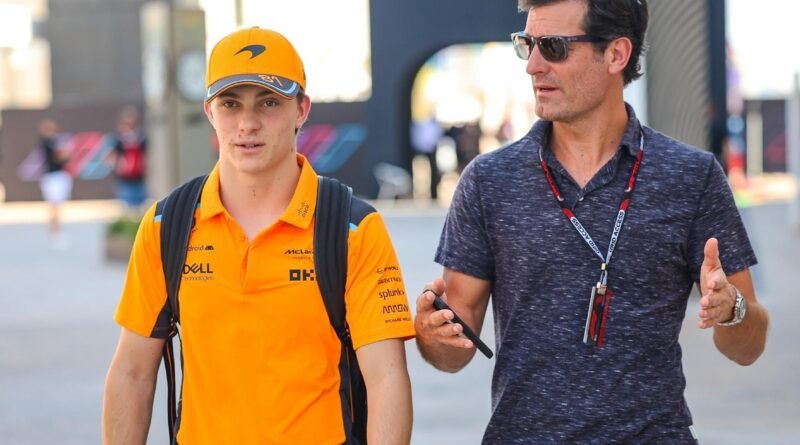
What’s behind Oscar Piastri’s split with Mark Webber – and what it means for his F1 career
On the Monday after the Formula 1 Brazilian Grand Prix, Oscar Piastri and Mark Webber announced in a joint statement that the latter and Ann Neal would no longer manage the 25-year-old McLaren driver. The timing may come as a surprise – now rather than at the end of the season – but the news itself had been on the cards for some time.
The clearest hint came from Piastri during pre-season testing in Bahrain. While this writer was mainly interested in his opinion of the 2026 cars – which immediately brought a telling smile to Piastri’s face – an Australian colleague raised the subject of Webber’s changing role.
“There wasn’t anything specific, we just made a decision for things to look a bit different,” Piastri said on that unusually cold February evening in the Bahrain paddock. “Mark is still very much involved and I’ve been in contact with him a lot over the last few weeks. He just won’t be trackside as much anymore. So that’s really the extent of it. There was nothing specific that triggered it.”
Although that last point is essentially true, it is clear that the 2025 season was intense on several fronts – including behind the scenes, at least from Webber’s perspective. That was naturally closely linked to the ‘papaya rules’ through which McLaren tried to treat both drivers as fairly as possible, but which also made life difficult for the team at certain moments, as Andrea Stella frankly admitted at the beginning of this year.
It is no secret that Webber was not always happy with how McLaren handled certain moments on track, nor with the explanation for Piastri’s dip in form during the final quarter of the season, which ultimately cost him the world title. It is important to emphasise, however, that a manager’s role is also to defend the interests of his own driver, even though there are multiple ways of doing so.
Webber naturally had the experiences from his own Red Bull years in mind and wanted to prevent Piastri from ever being labelled a number two driver in the F1 paddock. In a recent interview with Autosport, former Red Bull team principal Christian Horner even described this as a key part of Webber’s mentality, a worldview that Horner believes he brought into the cockpit.
“I think probably the difficulty with Mark was, he motivated himself through adversity. He always drove better when he felt that the world was against him,” Horner said. “He could see this talent emerging in Sebastian [Vettel], and he was using everything in his locker to try and destabilise that, or to cause any tension in a way that would then fall back in his favour. I think as a team we were learning how to handle these dynamics.”

Watch: Christian Horner on Toto, Abu Dhabi 2021 and Life After Red Bull.
The differences between Red Bull back then and McLaren today are considerable, however. Red Bull was led at the time by Horner and Helmut Marko, two men who were certainly no strangers to the political side of F1, whereas McLaren is now much more engineering-led under Andrea Stella, who constantly emphasises the principles by which he wants to go racing – including fairness. This brings a different dynamic and also means that any attempts to avoid being pushed into a number two role are viewed in a completely different light.
It must be emphasised that McLaren has never formally asked Piastri to change his management, but Motorsport.com understands that the driver himself, with some input from those around him, has formed his own view of what he needs going forward.
In any case, the decision had already been made at the beginning of this year for Webber to take a step back and operate primarily ‘behind the scenes’ rather than being in the spotlight during race weekends. With hindsight, that was a first step towards this split, which, according to the statement, has come about by mutual agreement. “Following our reduced trackside involvement this season, we have collectively agreed that now is an appropriate time to bring our management agreement to a close,” Webber said.
Piastri’s development and a new reality in the F1 driver market
Aside from all that, it must also be said that Piastri’s situation is very different now from what it was at the beginning of his career. Consequently, what he needs from the people around him has changed as well. This applies in two areas: his experience as a driver and the current situation in the F1 driver market.
In his younger years, Piastri needed Webber’s experience as a racing driver more than he does now. When the Australian made his F1 debut at the age of 21 – and was, as Toto Wolff tends to describe young drivers, still a “deer in the headlights” – it helped to have a trusted figure by his side who had already experienced it all. Someone outside the team who was concerned solely with his interests and could help him avoid potential pitfalls.
When Motorsport.com spoke to Piastri in Barcelona during his debut season, that was precisely the added value he highlighted: “Mark’s advice was to not underestimate the challenge of F1 and how big of a step up it is, not just from the cars but from everything: the amount of people you need to interact with, the media commitments, and the sponsor commitments. It’s all much higher than before. I think having him reminding me of that before the season started was nice, not to be shocked when I arrived. That’s probably been the biggest thing.

Oscar Piastri, McLaren F1 Team, 2nd position, is congratulated by Mark Webber in Parc Ferme
Photo by: Steven Tee / Motorsport Images
“But he’s very helpful with small driving tips here and there as well, and sometimes thinking of questions for the engineers that don’t even come to my head at the moment.
“He’s still very sharp. He thinks like a racing driver still and is always trying to get the best out of me.”
More than three years later, Piastri has experienced all of this himself and therefore needs that hands-on guidance as a driver less than he did during his rookie season. Logically, this means that a different type of management can now suffice, with different priorities in that respect as well.
Moreover, the situation in the driver market has changed. Piastri is committed to McLaren for the longer term, with a contract running until the end of 2028. Yes, an extraordinary amount has been said and written about Piastri’s seat this summer, particularly in light of the Max Verstappen rumours, which have been blown considerably out of proportion by certain publications. In reality, however, the Dutchman indicated that he had come much closer to retiring from F1 than to moving to another team, meaning Piastri has not seriously been looking elsewhere either.
He did describe it as ‘flattering’ that his name was linked with Red Bull during the summer months, but the reality is that this route appears to be closed for the coming years. After all, Verstappen has extended his contract, meaning Red Bull – provided it gives him a competitive car – has its lead driver in place. And with talents such as Isack Hadjar, Arvid Lindblad and perhaps Nikola Tsolov in the longer term, Red Bull appears perfectly capable of filling its second seat from within its own talent pool.
Add to that the fact that Mercedes and Ferrari also still have long-term lead drivers in Kimi Antonelli and Charles Leclerc, and maintaining and further strengthening his relationship with McLaren seems far more important for Piastri than having contacts elsewhere, for example through Webber at Red Bull. These two factors may still make the timing surprising, but not so much the decision itself to end the partnership after Webber had already taken a step back.

Oscar Piastri, McLaren with Mark Webber
Photo by: Getty Images
Finally, it must be said that Webber did play a key role in the early years of Piastri’s career, one that should not be forgotten at a moment like this. Indeed, Piastri himself has not forgotten it either, as his quote in the joint statement demonstrates: “I’d like to thank Mark and Ann for all their support and advice over the years. Their guidance has been invaluable, particularly in navigating the beginning of my F1 career. I wish them all the best going forward.”
The most important move, of course, was leaving Alpine for McLaren, including Piastri’s now-famous tweet. That was a period in which Webber’s ‘us against the world’ mentality, as Horner described it, proved particularly useful. The move also saved Piastri from the quicksand that Alpine was, especially at that time. It is a decision for which he remains grateful, but this phase of his career calls for something different, and that explains why the partnership between two of the four most recent Australian F1 drivers has come to an end.
Webber played an important role in getting Piastri to where he is today, and the current seventh-placed driver in the championship has not forgotten that. But he feels that something different is needed for the next phase of his career, ideally one of harmony within McLaren – and, given all of the above, that is understandable.
We want your opinion!
What would you like to see on Motorsport.com?
– The Motorsport.com Team