
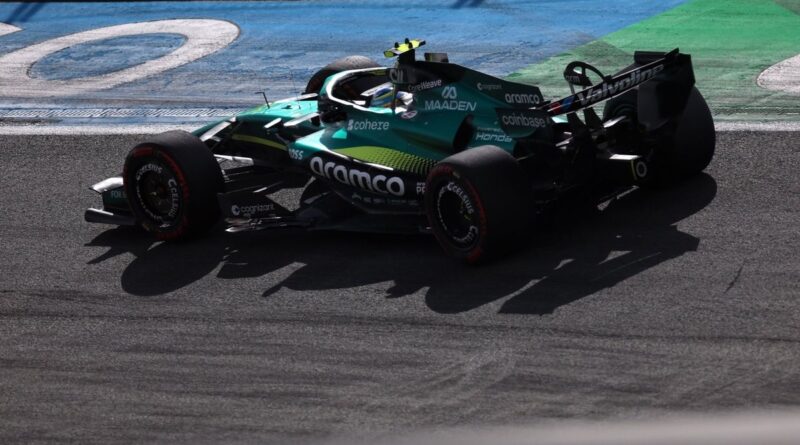
The key area Honda still needs to improve with its new F1 engine
After Adrian Newey’s first major upgrade package in Hungary for Aston Martin, Honda introduced its first power unit update of the Formula 1 season in Zandvoort.
Chief engineer Shintaro Orihara explained that the upgrade was entirely focused on the internal combustion engine, although in Zandvoort he brought a piece of paper with him to his media session to stress that he absolutely did not want to talk about the gains in terms of horsepower or lap time.
In Monza, Orihara no longer has that piece of paper with him, which prompted him to joke: “Now you can ask me everything!”
Honda still does not want to disclose any numbers when it comes to horsepower, although Orihara did say the progress with this first ADUO upgrade is fully in line with expectations, when asked about it by Motorsport.com.
“So we introduced a new spec engine in the Netherlands and we have observed a step forward in terms of performance, as expected in our metrics,” he said. “We have confirmed what we saw on the dyno, so that was a positive thing that we found in the Netherlands.”
However, the race weekend in Zandvoort also showed that there still was work to be done.
“On the other hand, we found some things to improve in terms of driveability. So we have updated our combustion characteristics and then we prepared the data settings and the tools to adapt to these new combustion characteristics to get better drievability,” Orihara continued.
“But it was not enough to satisfy the drivers. So that is definitely our improvement point that we found in the Netherlands.”

Shintaro Orihara, Honda, during an interview with Ronald Vording, Motorsport.com
Photo by: Honda Racing Corporation
Driveability refers to the feeling drivers get from the power unit. The fact that this feeling is not yet entirely where Honda wants it to be, nor fully consistent throughout the lap, does not come as a surprise.
Orihara had already flagged this at Spa-Francorchamps in an exclusive interview with Motorsport.com, meaning Honda knew it still had work to do after bringing its first ADUO upgrade to the track. Some of that work has already been carried out in the 10 days since Zandvoort.
“We brought back all data to the dyno and we brought back all driver feedback to the dyno,” Orihara continued. “They have carried out some testing in HRC Sakura to improve our controls to get better driveability. So the main focus point for this weekend will be to confirm those countermeasures in Monza.”
Asked exactly what the driveability issues are, Honda’s chief engineer for the F1 project explained that it was a complex picture involving several different aspects.
“If you say driveability, that contains the shifting and the combustion stability during the braking phase, and also during the engine braking phase and torque pickup,” Orihara detailed. “A lot of things combine into driveability and we need to improve the full area.
“So the main issue is how we control our combustion and how we get stable combustion. That is the main focus point to improve our full driveability.”

Aston Martin technical detail
Photo by: Alessio Morgese
While Honda is primarily looking for stability with the new combustion characteristics, Aston Martin chief trackside officer Mike Krack stressed that driveability was also linked to the chassis.
“Driveability is not only a PU topic, driveability is also a chassis topic, so we need to work together on this, trying to understand everything,” Krack said.
“You want to go for the optimum, but also you want to be consistent with different levels of regen, with different levels of braking, and with different levels of downshifting. It’s not an easy exercise.
“I think it’s something that every team is learning and that every team really has to optimize for each section of the track. At the end of the day, when speaking about driveability, we must not only look at the PU but also at the whole thing. All the elements of the chassis and the PU are involved.”
As these aspects improve, Honda believes it can also extract a little more performance from the Zandvoort upgrade, although this will not amount to a major step as there will be no further hardware changes.
“Still, we think we have some room to improve performance by optimizing the data,” Orihara said. “We have brought some calibration changes for this track to maximize our performance, but it’s not going to be a big change, just optimizing.”
We want your opinion!
What would you like to see on Motorsport.com?
– The Motorsport.com Team