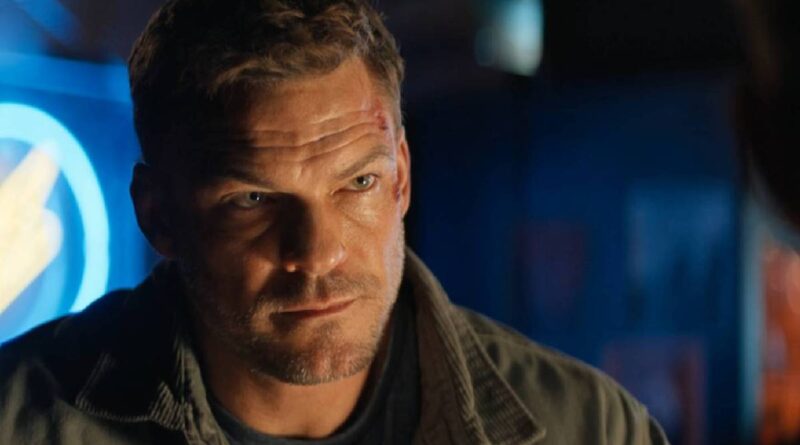
Prime Video’s Reacher has more than two dozen Jack Reacher novels left to choose from for future seasons, but Lee Child believes there’s at least one that could present an unusually difficult problem. It isn’t because the story is too violent, too expensive, or impossible to squeeze into eight episodes, either. The problem is snow. Lots and lots of snow. Child recently sat down with Collider ahead of his new Reacher novel Chain Reaction and revealed which of his books may present the biggest challenge to Prime Video’s hit series should they choose to tackle the stories on screen.
Speaking exclusively with Collider, he explained that the fan-favorite novel 61 Hours‘ snow-covered South Dakota setting is so integral to the story that recreating it for television could become a logistical nightmare. 61 Hours is one of the most popular Jack Reacher novels, due to its unique, icy setting and the intense isolation it creates. It truly takes Reacher out of his comfort zone, but Child isn’t convinced it can realistically be done. He told Collider:
“61 Hours I would love to see, but that sort of thing is impossible to make because it depends on snow. You can’t plausibly shoot in snow because you’ve got this virgin, snow-covered landscape. You can only ever do take one.”
And unlike other aspects of a novel that can be altered relatively easily when making the jump to television, removing the snow isn’t much of an option. When Collider pointed out that the weather is essential to the story, Child agreed, saying, “You need reliable snow, and then you can’t do multiple takes because there’ll be footprints all over the place. So that one’s probably not possible.”
Collider Exclusive · Sci-Fi Survival Quiz Which Sci-Fi World Would You Survive? The Matrix · Mad Max · Blade Runner · Dune · Star Wars
Five universes. Five completely different ways the future went wrong — or sideways, or up in flames. Only one of them is the world your instincts were built for. Eight questions will figure out which dystopia, galaxy, or desert wasteland you’d actually make it out of alive.
💊The Matrix
🔥Mad Max
🌧️Blade Runner
🏜️Dune
🚀Star Wars
01
You sense something is deeply wrong with the world around you. What do you do? The first instinct is often the truest one.
02
In a world of scarcity, what resource do you guard most fiercely? What we protect reveals what we believe survival actually requires.
03
What kind of threat keeps you up at night? Fear is useful data — if you’re honest about what you’re actually afraid of.
04
How do you deal with authority you don’t trust? Every dystopia has a power structure. Your approach to it determines everything.
05
Which environment could you actually endure long-term? Survival isn’t just tactical — it’s physical, psychological, and very much about where you are.
06
Who do you want in your corner when things fall apart? The company you keep is the clearest signal of who you actually are.
07
Where do you draw the line — if you draw one at all? Every survivor eventually faces a moment that tests what they’re actually made of.
08
What would actually make survival worth it? Staying alive is one thing. Having a reason to is another.
Your Fate Has Been Calculated You’d Survive In…
Your answers point to the world your instincts were built for. This is the universe your temperament, your survival instincts, and your particular brand of stubbornness were made for.
The Resistance, Zion
The Matrix
You took the red pill a long time ago — probably before anyone offered it to you. You’re a systems thinker who can’t help but notice the seams in things.
You’re drawn to understanding how the system works before figuring out how to break it.
You’d find the Resistance, or it would find you — your instinct for spotting constructed realities is the machines’ worst nightmare.
You function best when you have access to information and the freedom to act on it.
The Matrix built an airtight prison. You’d be the one probing the walls for the door.
The Wasteland
Mad Max
The wasteland doesn’t reward the clever or the well-connected — it rewards those who are hard to kill and harder to break. That’s you.
You don’t need comfort, community, or a cause larger than the next horizon.
You need a vehicle, a clear threat, and enough fuel to outrun it — and you’re good at all three.
You are unsentimental enough to survive that world, and decent enough — just barely — to be something more than another raider.
In the wasteland, that distinction is everything.
Los Angeles, 2049
Blade Runner
You’d survive here because you know how to exist in moral grey areas without losing yourself completely.
You read people accurately, keep your circle small, and ask the questions others prefer not to answer.
In a city where humanity is a legal designation rather than a feeling, you hold onto something that keeps you functional.
You’re not a hero. But you’re not lost, either.
In Blade Runner’s world, that distinction is everything.
Arrakis
Dune
Arrakis is the most hostile environment in the known universe — and you are precisely the kind of person it rewards.
Patience, discipline, and political awareness are your core strengths — and on Arrakis, they’re survival tools.
You understand that the long game matters more than any single victory.
Others come to Dune and are consumed by it. You’d learn its logic and earn its respect.
In time, you wouldn’t just survive Arrakis — you’d begin to reshape it.
A Galaxy Far, Far Away
Star Wars
The galaxy far, far away is vast, loud, and in a constant state of violent political upheaval — and you wouldn’t have it any other way.
You find meaning in being part of something larger than yourself — a cause, a crew, a rebellion.
You’d gravitate toward the Rebellion, or the fringes, or whatever pocket of the galaxy still believes the Empire’s grip can be broken.
You fight — not because you have to, but because standing aside isn’t something you’re capable of.
In Star Wars, that willingness is what makes all the difference.
Why Is ’61 Hours’ So Difficult to Adapt?
Published in 2010, 61 Hours strands Reacher in the freezing South Dakota town of Bolton after the bus he’s traveling on crashes during a snowstorm. What follows unfolds against a ticking clock as Reacher becomes involved with the local police department and a vulnerable witness whose testimony threatens a dangerous criminal operation. The snowstorm is massively important to the story because it’s the main reason why the characters are so isolated and see their movement restricted. Reacher famously struggles with the cold in the book, too. But if you take away the weather, you’d fundamentally alter the circumstances trapping Reacher in Bolton in the first place.
Child’s point about continuity is simple, because once actors and crew have walked through a pristine snow-covered location, resetting that landscape for another take becomes considerably more complicated than resetting a conventional set, and then there’s the even more basic issue of finding somewhere capable of providing the amount of reliable snow the story requires across an entire production.