
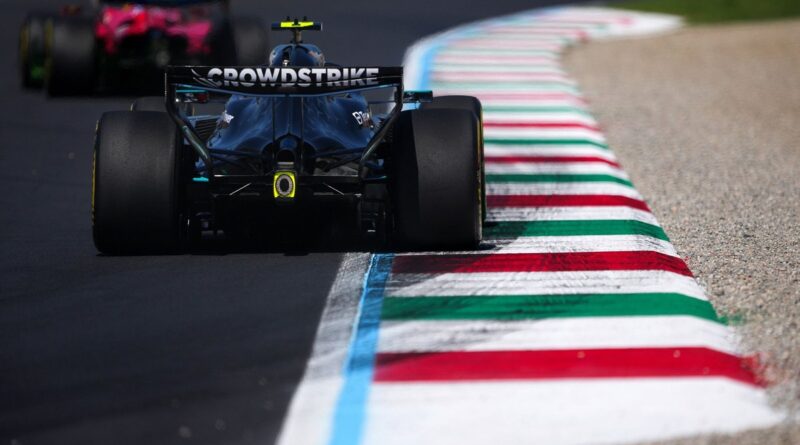
Italian GP long runs leave no clear favourite
After Charles Leclerc topped the opening practice session for Ferrari, Mercedes struck back in the more representative second practice session, with George Russell setting the fastest time.
That made the long runs at the end of FP2 particularly intriguing. They are considered an important indicator of potential race pace for Sunday. Yet the picture could hardly be any less clear.
Once the long runs are adjusted for different stint lengths and tyre compounds, Ferrari and Mercedes are virtually level. Charles Leclerc and Lewis Hamilton were exactly equal on pace (+0.00s), while George Russell was just two hundredths of a second per lap behind. Championship leader Kimi Antonelli was only 0.04 seconds off the pace per lap as well.
Mercedes vs Ferrari: Is different energy management key?
With Monza’s long straights and relatively few corners, energy management plays a particularly important role. And the two leading teams appear to have taken slightly different approaches: Mercedes seems to gain more time at the beginning of the lap, while Ferrari appears to claw it back in the final sector.
George Russell posted a 27.044s in the second practice session, the second-fastest time in the opening sector behind Pierre Gasly (27.039s). Ferrari, meanwhile, lost around one and a half to two tenths there, with Lewis Hamilton recording a 27.174s and Charles Leclerc a 27.259s.
Mercedes was also fastest of all in the second sector, with a 27.784s. Ferrari lost roughly another tenth in Monza’s most technical section, recording a 27.874s. In the final sector, however, the picture changed: Leclerc’s 27.546s was around two tenths quicker than FP2 winner Russell’s 27.721s.
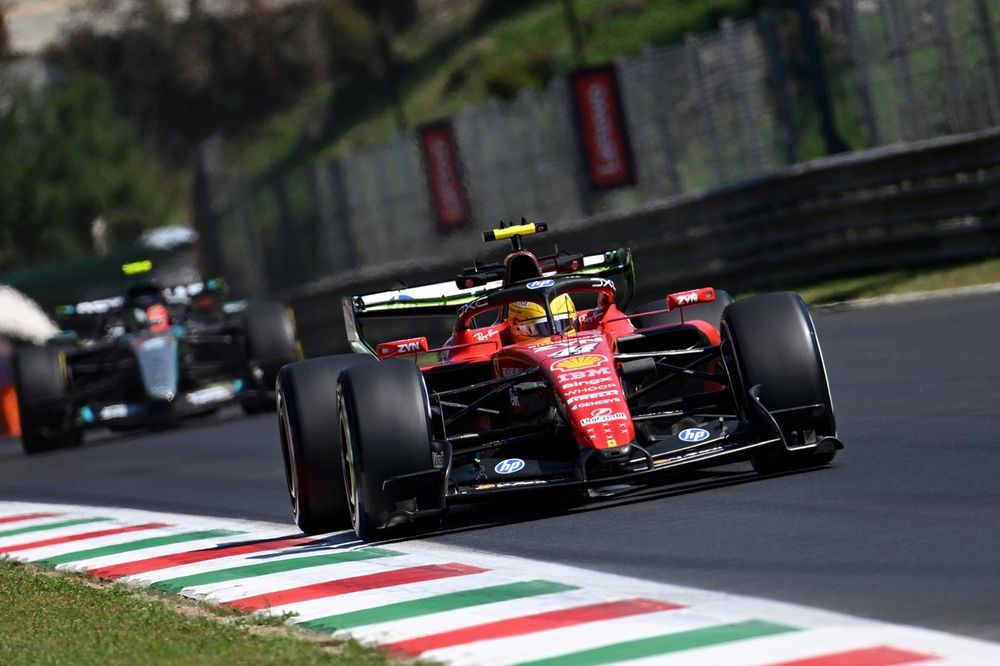
Lewis Hamilton, Ferrari
Photo by: Manuel Eletto / Getty Images
It therefore appears that Mercedes is using slightly more performance at the beginning of the lap, while Ferrari is making up ground towards the end. Who should now be considered the favourite for qualifying and the race remains completely unclear, however. The gaps are incredibly tight, and the smallest of mistakes could cost several positions at the front.
McLaren struggles, Red Bull out of contention
At the very least, it seems clear that Mercedes and Ferrari are likely to fight it out for the top positions. McLaren was around four tenths off the pace over a single lap in FP2. On the long runs, however, Lando Norris was only 0.19 seconds per lap off the benchmark.
Monza therefore does not appear to suit the MCL40 quite as well as the tighter, more technical circuits in Budapest and Zandvoort. Unsurprisingly, the Papaya team performs best in Monza’s second sector, but it is losing too much time, particularly in the final sector.
While McLaren has struggled with top speed and overall efficiency throughout the season, the same cannot be said of Red Bull. Its internal combustion engine is regarded as the benchmark in Formula 1, while the Red Bull has also appeared to be at the other end of the spectrum when it comes to aerodynamic drag.
Nevertheless, Red Bull appear to be the fourth-best team at best on Monza’s high-speed layout. The qualifying simulations (+0.818s) and long runs (+0.22s) both point in that direction. The team appears to be somewhat closer when it comes to race pace, but the fundamental problem remains: the RB22 loses too much time through the corners in the first two sectors, and it can no longer make up that deficit on the straights.

Gabriel Bortoleto, Audi F1 Team
Photo by: Andy Hone/ LAT Images via Getty Images
Audi struggles as Alpine makes a comeback in the midfield fight
The balance of power in the midfield also appears to have shifted somewhat as a result of Monza’s unique track characteristics. While Racing Bulls still seems to be leading the midfield, the previously strong Audi team may have slipped back.
The works team appears to be particularly lacking in engine performance, something that is especially costly at Monza. Alongside only average qualifying simulations (+1.173s), Audi’s long runs were also nothing to write home about.
Gabriel Bortoleto managed just three laps before a technical issue brought his running to an end. His team-mate Nico Hulkenberg was 1.42 seconds per lap off the benchmark in his more representative long run.
That left Audi not only behind Racing Bulls (+0.72), but also behind Alpine (+0.88), Williams (+1.24) and Haas (+1.28).
Aston Martin also appears to be struggling after showing improved form recently. Fernando Alonso was unable to complete any meaningful long runs, while Lance Stroll’s were 3.94 seconds per lap slower than the benchmark. That left Aston Martin well behind Cadillac (+2.20) once again.
Following Friday’s practice sessions, the strategic picture should be considerably easier to assess than the competitive order itself. The long runs showed no significant tyre degradation on any of the three compounds. As a result, a one-stop strategy on all possible tyre combinations appears preferable to a two-stop strategy on Sunday.
We want your opinion!
What would you like to see on Motorsport.com?
– The Motorsport.com Team