
From washing dishes to World Cup hero: The epic story of England’s 1950 nemesis Joe Gaetjens
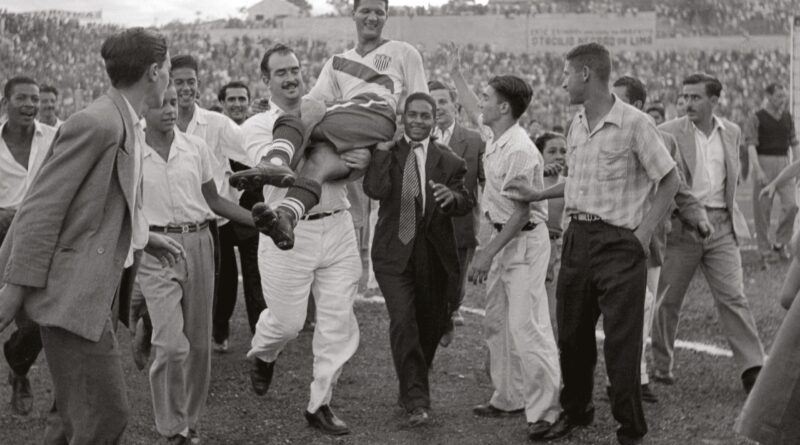
June 29, 1950. A player with a broad grin on his face is being carried shoulder-high by a group of excited local fans in Belo Horizonte, Brazil. His name is Larry ‘Joe’ Gaetjens and his team, the United States of America, have just beaten England 1-0 in the group stage of the fourth edition of the World Cup. Gaetjens scored the goal, and although it was a header, it soon became known as ‘the shot heard round the world’.
Gaetjens wasn’t even a US citizen at the time. He arrived in New York from Haiti in 1947, having won a scholarship to study accountancy at the prestigious Columbia University. To help make ends meet, he took a job washing dishes in a German restaurant.
Back in Haiti, he’d played football for Etoile Haitienne, and even earned caps for the Haiti national team. Eager to continue playing in the US, he asked his boss if he could fix him up with a team. “I hope you play soccer better than you wash dishes,” he was told, before going on trial with local side Brookhattan, who were playing in the semi-professional American Soccer League.
Gaetjens may not have been the most gifted of kitchen hands, but he could certainly play football. An intelligent and energetic centre-forward, he was the second highest scorer in the ASL for the 1947-48 season and topped the charts two years later, despite the fact that in the World Cup year, Brookhattan ended up bottom of the league.
It was still something of a surprise, however, when he was picked in the US squad at their third World Cup finals – they’d lost 7-1 to Italy in 1934, but had actually reached the semis in 1930.
It wasn’t Gaetjens lack of citizenship that caused shock over his selection – in those years a statement of intent to become a citizen in future was enough – but because he hadn’t represented the country before.
He hadn’t been picked for the USA’s ill-fated 1948 Olympics squad, when they lost their only game 9-0 to Italy. Neither had he played in the World Cup qualifiers in 1949, when they lost 6-0and 6-2 against Mexico but managed a win and a draw against Cuba to reach the finals. He also hadn’t featured in the warm-up game shortly before the World Cup, when the USA lost 5-0 to Besiktas.
But Gaetjens had impressed in a trial game played in St Louis to finalise the squad, and was picked for the unofficial match the USA played against a touring FA XI, which included Nat Lofthouse and Stanley Matthews, the week before the team left for Brazil. He must have been delighted to get into the squad, because the USA had a mouth-watering group featuring Spain, Chile and England.
Pick the ultimate 4-4-2 line-up from players in FourFourTwo’s definitive Top 100 List
For Gaetjens, facing World Cup favourites England was the stuff of dreams – the Three Lions squad featured an array of stars such as Wilf Mannion, Tom Finney, Stan Mortensen, Billy Wright and Jackie Milburn, with future legendary managers Bill Nicholson and Alf Ramsey also on Walter Winterbottom’s roster.
England had never entered the World Cup before – a strained relationship with FIFA had resulted in them leaving the organisation altogether between 1928 and 1946 – but they were highly fancied to win the trophy.
During the most recent British Home Championship, which doubled up as qualifying for the World Cup, they had beaten Wales 4-1 in Cardiff, thrashed Ireland 9-2 at Maine Road, then beat Scotland 1-0 in front of 138,000 people at Hampden Park. The top two earned spots at the World Cup, although the second-placed Scots opted not to take up their place, having said they’d only travel to Brazil if they won the Home Championship. Despite protests from some of their players, they instead went on a tour of North America.
Soccer in the USA was a ramshackle affair in the late 1940s and early 1950s. There was no national league, with the game only played seriously on the east coast, as well as immigrant-heavy cities like Chicago and St Louis. Players were semi-pro, working 40-hour weeks.

Midfielder Walter Bahr remembered making $550 a week as a PE teacher, but just $25 for a match at the weekend. Striker Gino Pariani recalled practising twice a week in the local park. “When it was dark, we’d train using the lights from the cars we’d come up in,” he said.
“The pitches were pretty terrible,” Bahr explained. “They were mostly cinder or dirt fields, or real cabbage patches.”
Once assembled, it took the squad three days to reach Rio de Janeiro, after which they had three days to acclimatise before their opening game with Spain. While England began the tournament as 3-1 favourites with the bookmakers, the Americans were 500-1 outsiders.
Their coach Bill Jeffrey, a Scot who’d been highly successful coaching Penn State University, had the job of choosing the team to face the Spanish. “He knew that a lot of the players weren’t used to playing together, but made sure that each knew someone in their part of the field,” explained Bahr.
Jeffrey took the core of his team from the same Italian district of St Louis, an area known as ‘The Hill’. Keeper Frank Borghi was a funeral director who had been decorated for treating a wounded German soldier during D-Day. Charlie Colombo, the centre-half, was known as ‘Gloves’ for his habit of playing in a pair whatever the weather. Pariani was a talented inside right who had been forced to bring his wedding forward by a week to play in the tournament.

Left winger Frank ‘Pee Wee’ Wallace had spent 15 months of the Second World War in a German prisoner of war camp. The only non-Italian among the St Louis players was Harry Keough, who was married to a girl from Guadalajara and spoke Spanish – a strong enough reason for Jeffrey to award him the captaincy in the opening game.
Alongside Bahr in midfield sat Eddie McIlvenny, a Scotsman from Greenock who’d turned out for Wrexham in Third Division North before emigrating. Playing at left-back was Joseph Maca, a Belgian who moved to the US after fighting in the resistance during the war.
When the USA faced Spain in Curitiba, a heavy defeat was expected. Against the run of play though, Pariani put them ahead, and they still led with 10 minutes to play. “But we weren’t in shape,” Bahr admitted. “We all had full-time jobs – we couldn’t keep up with their pros for the full 90 minutes.” Spain scored three late goals to turn the game on its head.
The same day, England had laboured to a 2-0 win over unfancied Chile in their opener with goals from Mortensen and Mannion. A hatful was expected against the USA in their second match, ahead of a showdown with Spain to determine the one team to go through, with goal difference potentially a deciding factor.
Their preparations for the USA game smacked of complacency. They hadn’t bothered scouting their opponents, or even inspected the pitch. Matthews was flown in from the FA’s tour of North America especially for the USA game, only for it to be decided that he wasn’t needed on the field.

England changed at a tennis club outside Belo Horizonte and travelled in, but were dismayed to see the condition of the playing surface when they ran out to warm up. “A lot was made of the state of the pitch,” Bahr later said. “But I don’t remember it being particularly bad. I guess we were used to a lot worse in the States.” The Americans’ relaxed approach was summed up by the fact that some of the team stayed up late partying the night before the game.
The 10,151 fans inside the stadium included a few American soldiers and workers from a British-run mine nearby, but the vast majority were Brazilians. “We could tell they wanted us to win,” said Borghi. “They wanted England out of the tournament so Brazil would have a better chance of winning it.”
England fashioned six good chances in the first 12 minutes, hitting the post twice, with Borghi in inspired form. The Three Lions poured forward again and again, until the moment that took the stadium by surprise, six minutes before the half-time interval.
McIlvenny found Bahr, who stepped forward and fired in a shot from outside the area. “It was maybe 25 yards out, a decent shot,” recalled Pariani. “The England keeper moved right to cover it, but suddenly Joe Gaetjens jumped in and deflected it in the opposite direction. Before the goalkeeper realised what had happened, it was in the back of the net.”
Gaetjens himself didn’t see the ball go in – as it hit the back of the net, he was lying face down in the mud. “Joe didn’t celebrate madly, you never did in those days,” Bahr said. “We just shook his hand and he jogged back to the halfway line with a big grin on his face.”

The Americans’ goal took the wind out of England’s sails, and their attacks grew less persistent during the second half. The USA could even have got a second when Wallace went through on goal.
Late on England rallied, knowing their opponents were tiring again. Mortensen ran through the USA defence and was shaping up to shoot when Colombo brought him down from behind with a rugby tackle. “Charlie should have been thrown out of the match – nobody on our side would have complained,” Bahr later admitted. “The English wanted a penalty, but the Italian referee gave them a free-kick outside the box.”
From the kick, Jimmy Mullen’s header appeared to loop beyond Borghi and into the goal, but the keeper dived at full-length to somehow scoop the ball around the post. England appealed that it had crossed the line. “It definitely wasn’t a goal,” Bahr insisted. “It could have been on the line, but it definitely wasn’t over it.”
Come the final whistle, hundreds of excited Brazilian fans invaded the pitch, picking up two American players and carrying them toward the clubhouse. One was Borghi. “I didn’t know what was going on,” he laughed. “They just picked me up and carried me off.” The other was the match-winner, Gaetjens, who had carved his name forever into World Cup folklore.
News of the game hardly registered in the USA – only one American reporter was in attendance. Three days later, they lost 5-2 to Chile in the heat of Recife and were eliminated, finishing bottom of the group on goal difference. England had to beat Spain 3-0 in their final game to qualify, but lost 1-0.
On their return home, the Three Lions team were criticised by the press, but not to the same extent as they might face for a similar elimination nowadays. More coverage was given to the West Indies cricket team’s first ever Lord’s victory over England, which happened on the same day as the defeat to the USA. “It was just one of those games,” Tom Finney later told FFT of the USA loss. “We could have played for nine hours and still wouldn’t have scored.”
Gaetjens never would become a US citizen. In fact, he never played another game for the USA after that World Cup, moving to France and playing for Racing Club de Paris, and later heading home to Haiti. He lined up again for the Haitian national team in a qualifier for the 1954 World Cup – they lost 4-0 to Mexico.
In 1964, after retiring from football to run a dry-cleaning business, he was arrested by Haiti’s secret police, acting on behalf of president Francois Duvalier, who’d risen to power seven years earlier.
“Joe didn’t have a political bone in his body,” his former USA team-mate Bahr insisted. His family did, however, and their support for opponents of Duvalier’s brutal dictatorship was enough to seal his fate with the regime.
Gaetjens was last seen alive two days later in Haiti’s notorious Fort Dimanche prison, where thousands were murdered. His body was never found.
This article first appeared in the April 2006 edition of FourFourTwo magazine