F1 2026 isn’t just unnatural, it’s too easy to drive
Max Verstappen believes Formula 1’s new power units have taken so much away from the driving challenge that performing to a high level has become somewhat effortless.
Verstappen has been perhaps the most vocal critic of F1’s new machinery, which he described as “Formula E on steroids” early on, due to the very different driving style induced by the required energy management.
“In the history of the sport, normally the driver that is the most committed, the latest on the brakes, earlier on throttle, committing in the high-speed [corners], they get rewarded, because you just gain that time in the corner,” the Red Bull driver told the BBC.
“But now you’re constantly thinking about, ‘In this corner I might have to hold in a bit. Go later on throttle. Or brake earlier. Or lift off. And then I have more top speed.’ Stuff like that. It’s so unnatural. It’s so not how it should be.”
Verstappen reckoned his point was proven by Liam Lawson and Yuki Tsunoda, who have been standing in at Red Bull and Racing Bulls respectively following Isack Hadjar’s wrist injury in the summer break.
Lawson took a fine seventh in Zandvoort, though he endured a trickier Italian Grand Prix, while Tsunoda scored a point in Monza after the top 10 narrowly eluded him in the Netherlands.
“No disrespect. And I hope no one picks up on this,” he continued. “But look at Yuki [Tsunoda]. He jumps in the car. Never driven the car before. Immediately competitive.

Liam Lawson, Racing Bulls
Photo by: Sam Bagnall / Sutton Images via Getty Images
“Liam [Lawson] jumps from the Racing Bulls to the Red Bull – immediately competitive. It’s because these cars are numb to your driver inputs.
“Of course, yes, you still have to do a good lap. And you still have to commit. The fastest drivers will always come out on top. But it’s really, really limited, like a choke hold or something. You’re held back.”
One should point out both Lawson and Tsunoda were outqualified by their respective team-mates in all three qualifying sessions at Zandvoort and Monza, while across all eras of F1 there have always been instances of stand-in drivers scoring impressive results.
To name but a few, Nico Hulkenberg qualified a remarkable third with Racing Point in 2020’s 70th Anniversary Grand Prix, a year when George Russell very nearly won the second Sakhir round for his first race in a Silver Arrow.
Going back to the pre-hybrid era, Sebastian Vettel scored a point on his F1 debut with BMW in 2007, while it took rookie Robert Kubica just three races to reach the podium when he replaced Jacques Villeneuve at the same team halfway through the 2006 season. The previous year, Alexander Wurz finished third at Imola – the only race he competed in in 2005.
Of course, Verstappen himself won his very first race in a Red Bull car, at just 18 years of age, in the fifth round of the 2016 campaign.

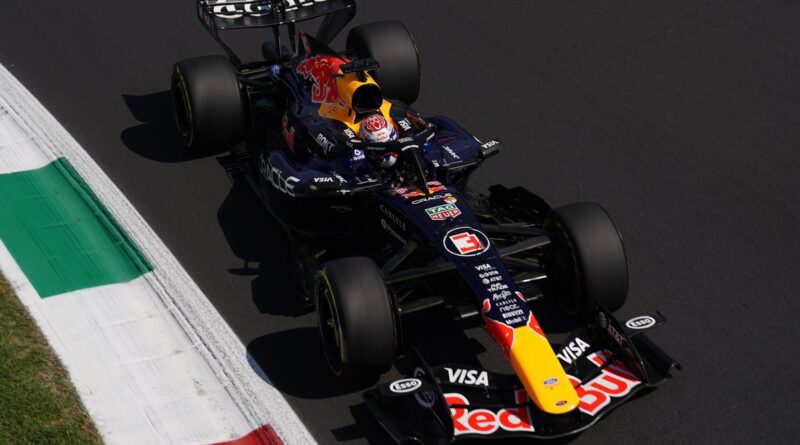
Max Verstappen, Red Bull Racing
Photo by: Peter Fox / Getty Images
The 2026 intra-team gaps indeed are slightly smaller than they were in last year, but this doesn’t prevent some noticeable differences from one driver to another in qualifying. Since the April break, Lance Stroll has been 0.300s slower than Fernando Alonso on average at Aston Martin while, even at top teams, Hadjar has been 0.196s down on Verstappen and Russell is 0.130s adrift of Kimi Antonelli. So it is possible to make a difference – albeit not in the same way.
The power unit balance will shift from 47% electrical energy to 42% next year and 40% in 2028, which should appease Verstappen, who previously hinted at leaving F1 over discontent regarding the current rules.
Asked what convinced him it was worth extending his stay in the world championship, the Dutchman said: “Hoping that it will be better in the future. Accepting where we are at the moment. Still the love for the sport. Not at the moment the driving. But the love for the sport.
“I love competition, naturally. I just hope that in the coming years, towards 2030, it can only get better. And to start to make the best of it, because these are the rules for the next four or five years.”
As for the engine formula Verstappen would like to see in the early 2030s, it is pretty straightforward: “It has to go back to a V8, just for drivability already. When you drive the old cars, you cannot imagine the difference in how the engine responds, or the drivability you get. And how terrible or horrible it actually is now compared to just having a V8.”
We want your opinion!
What would you like to see on Motorsport.com?
– The Motorsport.com Team