
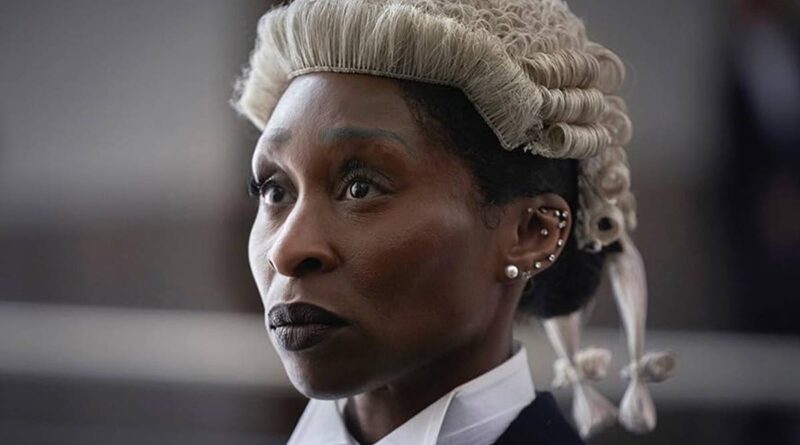
Cynthia Erivo Delivers an Instant Classic Performance in ‘Prima Facie’
Based on Susie Miller‘s 2019 play of the same name, Prima Facie tells the devastating story of a defense attorney (or barrister, if you prefer) who spends her life defending criminals — specifically those accused of sexual assault — only to become the victim of a sexual assault herself. The one-woman play, which initially debuted in Sydney with Jodie Comer as the lead, finds a new life in Susanna White‘s latest film for TIFF, this time casting Cynthia Erivo as lead character Tessa, and expanding the parameters of the story into a full cast narrative. While Miller’s new screenplay and White’s sharp eye for direction give the story its legs, Erivo’s strong and impassioned performance is ultimately what makes the film land as hard as it does.
What is ‘Prima Facie’ About?

What stands out immediately in Prima Facie is its approach to Tessa’s character. When we are first introduced to her, she’s a brilliant and somewhat arrogant barrister, one who is as bloodthirsty and shark-like as her fellow colleagues when it comes to defending her clients in court. As someone who defends those accused of crimes, Tessa’s job is to look at the facts of the case and the evidence presented. Any trip-ups or inconsistencies laid forth by the witnesses allow her to laser-focus on their statements, debunking them and ultimately offering enough plausible deniability to allow her clients to go free. When asked by one of her associates after a case if she thinks her client is actually guilty or not, she answers firmly that it doesn’t matter what she thinks; that’s not part of her job.
Tessa, who was raised by a cleaner and attended Cambridge on a scholarship, comes from a different class than her peers and has worked hard to achieve her position. Being an expert at her job has gotten her noticed not only by the higher-ups at work, who are eyeing her for a promotion, but also by her colleagues who admire her ruthlessness in the courtroom. When she strikes up a rapport with her co-worker Julian (Daniel Ings), their flirtation quickly escalates into dates, a hook-up in their chambers, and a blossoming romance.
However, everything takes a turn for the worse when, one night, Julian rapes Tessa. She is left frozen in fear, trying to piece herself back together while also filing a police report against Julian and subsequently being ostracized by her friends and co-workers. Forced to defend herself against a system that she knows is stacked against her, Tessa must do everything she can to plead her case, and finds herself in the shoes of so many women before her, as she takes the stand and tries to seek out justice for herself.
‘Prima Facie’ Lets Cynthia Erivo Shine

Erivo’s performance as Tessa shines the brightest in Prima Facie. When we first meet her, she’s quite literally the definition of a girlboss: She is fiercely sure of her position as a barrister and never once second-guesses her own actions. As we watch her pick apart statements from witnesses and plaintiffs, it’s impossible to deny that she’s skilled at her job — even if that skill is defending a man who is, in all likelihood, a rapist. It’s this aspect that also gives Tessa’s character nuance, compared to other stories that might cover the same subject matter. Oftentimes, defense attorneys in films are portrayed as either heartless villains or underdog lawyers fighting against the wrongfully convicted; there’s rarely anything in between. But it’s Tessa’s nuance that makes us want to root for her, even when we know she bends ethics and morality to defend her clients — whether she’d like to admit it to herself or not.
Erivo slips into Tessa’s role with ease, both in the film’s more light-hearted first half and in the heavier beats of its conclusion after her assault. Ambitious and hard-working, Erivo embodies Tessa with a self-assured air, towering in her stilettos and sleek suits. This appearance changes after the assault, as we see Tessa slowly shedding her skin. Her perfectly coiffed and dyed wigs are switched out for her natural curls, and although her polished veneer has cracks in it, she’s still as tough as nails. Her most stirring performance lies in her final monologue when she addresses the judge in her case, giving a passionate speech about how her perspective on the law and sexual assault cases has changed. This is a woman who is at the top of her field, and hearing her admit that the laws we use to judge these cases are unfair to witnesses means something. Her understanding of the intricacies of law and her passion for her career and justice make the speech all the more compelling, with Erivo delivering each line of dialogue with the punch it needs.
Tonal Shifts and Pacing Work Against ‘Prima Facie’

The downside of the film comes more in the execution leading into the third act. If you were to go into Prima Facie without knowing anything about it, the sharp tonal shift that you’d experience during Tessa’s assault might be completely jarring. This is clearly intentional. Leading up to this point, Ings’ Julian seemed like the perfect guy. He’s privileged and comes from a good background, but he seemingly admires Tessa, and their romance, on the surface, is the thing romcoms are made of. Their playful hook-ups at work are light, and as they spend more time with each other, it seems like their relationship might actually become serious. However, the assault turns all of this sour.
Credit goes to White for managing to portray a realistic, if difficult to watch, rape scene, one that manages to carefully balance the violence of the crime without exploiting the scene for any form of titillation. But it’s after this point that the film grinds to a screeching halt. Part of this is because we lose Erivo’s snappy voice as Tessa’s internal monologue, which acted as a guide to her inner thoughts. To demonstrate the long and arduous process of a legal case, we see that Tessa has to wait 1107 days until her trial, all the while losing friends and becoming estranged at work because of her accusation. Here the tempo falters, struggling to find equilibrium as it inches toward the trial. It’s only when Tessa finally enters the courtroom that the energy of the scene picks back up.
Still, despite this hiccup, White’s sharp script offers a stirring story that nails what it’s like to face off against a court of law as a survivor of sexual assault. In one of the film’s best scenes, a journalist (Bronagh Waugh) speaks to Tessa after her case, offering her a bright light in an otherwise depressing conclusion. It’s a horrible reminder of just how pervasive sexual assault is among women. While White’s film is not exactly groundbreaking, her thoughtful approach and execution still make it well worth the watch and the praise.

- Release Date
-
November 13, 2026
- Runtime
-
106 minutes
- Director
-
Susanna White
- Writers
-
Suzie Miller
- Producers
-
David Jowsey, Greer Simpkin, Jenny Cooney, Kevin Loader
- Cynthia Erivo is the star of the film, giving one of her best performances.
- The concept of putting a defense attorney into the shoes of a sexual assault survivor is a smart switch-up on the story.
- The pacing near the beginning of the third act slows down the tempo of the film leading up to its conclusion.