Winners and losers from F1’s heated Hungarian Grand Prix
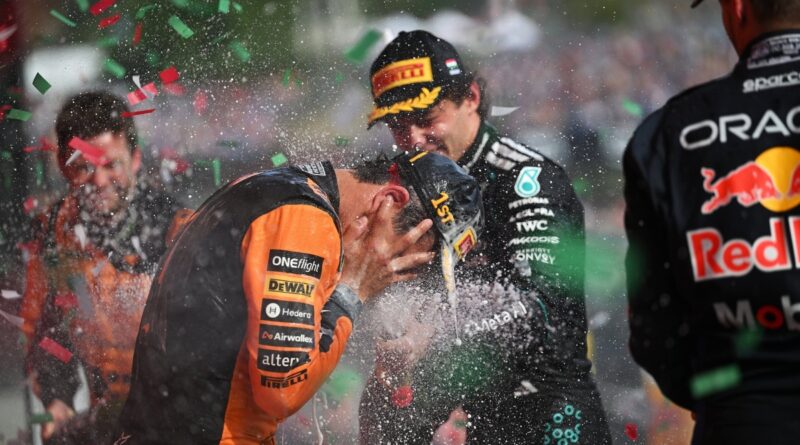
As F1 prepares for its annual summer shutdown, the 2026 season saw a new winner as McLaren joined Mercedes and Ferrari in the victor column off the back of an impressive car upgrade. The campaign looks set to be decided by which top team has the most bullets left in its chamber as the development war rages on. But some drivers and teams will head to the beach with a better feeling than others.
There was little doubt over who the quickest man was on Sunday afternoon. But Lando Norris almost didn’t get a chance to show it after a slip up in Turn 2, on which team-mate Oscar Piastri deftly capitalised by snatching the lead.
At a circuit where overtaking is difficult when on the same tyre strategy, Norris was effectively stuck, even as Piastri struggled for pace on the hard tyre. Passing him was extremely difficult and risky, while exploring an alternate strategy left Norris vulnerable to pressure from behind.
The only thing Norris could do was trying to pressure Piastri into a mistake, while also making it clear to the team both through his driving and on the team radio who the quicker of the two drivers on the day was. Some would call it classic racing driver petulance, some would call it racing. In any case, Norris’ impatience wasn’t particularly well received by his team, which tried to get him to settle down rather than take undue risk, as he went off the road in Turn 4.
As it happened, Norris received a helping hand from lapped traffic, as Williams’ Carlos Sainz veered into Piastri after the Australian’s pitstop, costing him enough time to allow Norris to make a rare overcut work.

Photo by: Alastair Staley / LAT Images via Getty Images
Loser: Oscar Piastri
It was desperately unlucky for Piastri, but things would get even worse when the Australian retired with a gearbox failure.
Some of Piastri’s frustration appeared to be directed at his team for its strategy choices, but he was big enough after the race to acknowledge that this had been heat-of-the-moment frustration, triggered by the sight of Norris emerging from the pitlane ahead of him through no fault of his own.
If anything, McLaren had followed the conventional plan of giving its lead driver the priority to pit first, which has been a staple in recent years because of how powerful the undercut is, especially in Hungary where fresh tyres make a huge difference.
Piastri’s stop on lap 34 – before Norris – therefore looked to cement his lead rather than threaten it, if it hadn’t been for the rare incidence of a lapped car causing a collision that cost him crucial time.
But at the same time Norris’ McLaren was easily the quickest car-driver combination on Sunday, and it confirmed a recent trend of Norris having a better handle on the 2026 car than Piastri.
There were mitigating circumstances, though, with Piastri sitting out FP1 for Leonardo Fornaroli and then not getting the latest floor specification until Saturday morning’s FP3, which particularly affected a driver that tends to take a bit longer over a race weekend to build up his pace and get into the groove.
McLaren’s latest upgrade was a crucial step forward. After the summer break, Piastri will still need to follow suit.

Photo by: Sam Bagnall / Sutton Images via Getty Images
Loser: Ferrari
Given the innate pace of Ferrari’s car, especially its cornering speeds and rear-end stability that has been the envy of the F1 paddock, the Hungaroring seemed like the perfect location for Ferrari to pile further pressure on an unreliable Mercedes team. The Budapest circuit’s many twists and turns also played in the Scuderia’s favour, masking its power unit deficit.
So, for Lewis Hamilton and Charles Leclerc to come away without a podium, and finish behind a car from each of its three top team rivals? That will lead to some head scratching in Maranello.
Ferrari isn’t usually trying to be the hero of Friday practice, but its encouraging pace seemed to legitimately put it in contention. But a choice to start on soft tyres didn’t pan out for either driver, having been stuck behind the medium runners over the first stint. When Hamilton did manage an undercut on Max Verstappen, he was immediately passed with a brave lunge into Turn 1.
Ferrari could never really overcome its disadvantageous track position from there, with Hamilton’s early pitstops not helping as the SF-26’s pace on hard tyres wasn’t particularly impressive. A pitlane speeding penalty for the Briton capped off a frustrating weekend.
“It’s not a good Sunday because when you are 1-2 on Friday, you expect much more than fourth and fifth,” Vasseur admitted. “We made too many mistakes today, starting with the start, with the penalty, with the fact that Max overtook us on track, that each time that we were doing a pitstop, we were losing a position for 0.2 or 0.3 seconds, and then you spend your life behind the [other] cars. Everything went wrong, but for sure we have to do a much better job on Sunday.”

Photo by: Alastair Staley / LAT Images via Getty Images
Winner: Max Verstappen
Max Verstappen isn’t one to suffer fools gladly at the best of times, but if you had told him on Saturday he would go on to finish on the podium, he would have flatly laughed you out of the room.
His frustration with the misbehaving RB22 reached a new low as even with its fixed rotating rear wing, the car’s inherent flaws caused a mysterious change in aero balance which led to Verstappen’s latest qualifying spin.
That Verstappen still managed to come through on Sunday with a bulletproof performance, including a hair-raising lunge in Turn 1 on Lewis Hamilton, despite suffering from the same ails spoke volumes on the Dutchman’s talent.
Red Bull then caught out Ferrari by staying out for a long final stint on softs, which Verstappen executed well.
“It was still a very tough race. I was still struggling with the same things as in qualifying, where the car is really, really oversteery at times and in different phases. So for most of the race, just trying to battle that,” he told Sky. “But I think we made a lot of good moves.”

Photo by: Clive Rose / Formula 1 via Getty Images
George Russell said he was numb to the disappointment of another bout of bad luck in Belgium, then his botched Hungary start that dropped him to 19th moved him “beyond” that.
This should have been his year, but having been challenged by a rapid and carefree Kimi Antonelli, Russell has needed everything to go his way to match the Italian. That hasn’t happened. While Antonelli has also partook in Mercedes’ worrying reliability problems, Russell has faced even more issues and driving wise he still hasn’t been able to hit his stride.
Entering the summer shutdown over two wins’ worth of points behind Antonelli, and also behind Ferrari’s Lewis Hamilton in the standings, was not supposed to be part of the script. He’ll have to find fresh inspiration over the summer break to write a more compelling scenario.

Photo by: Sam Bagnall / Sutton Images via Getty Images
Winner: Kimi Antonelli
Notwithstanding weekends where a part of Mercedes’s powerful yet frail power unit discombobulated, Antonelli has been a master of damage limitation and has found a consistently high level of performance that belies his tender years.
“Kimi is the one that’s just always there every single session,” Norris said after the race as Antonelli rallied to finish third ahead of the two Ferrari cars. That steady hand is the kind of trait you would associate with a seasoned veteran, not with a 19-year-old in his sophomore campaign.
Hungary was another piece of damage limitation when Mercedes didn’t execute a clean weekend at various levels. But Antonelli still leaves Budapest in a stronger championship position than he arrived.

Photo by: Sam Bagnall / Sutton Images via Getty Images
Winner: Aston Martin
Finishing 13th and 14th is the epitome of a “small win”, but it’s a victory nonetheless for the beleaguered Aston Martin outfit after a nightmare of a season so far. Aston Martin’s B-spec isn’t the finished article yet, and there will be further pace to exploit in conjunction with Honda’s new power unit in the Netherlands.
But it has at least delivered what Aston Martin wanted and badly needed. Respectability, a re-entry into 2026’s midfield and a foundation to keep building from. Designing and producing a completely new aero package around a lighter chassis is no small feat.
Aston is still falling well short of Lawrence Stroll’s lofty ambitions, but Hungary has given the Silverstone team a sense of direction for 2027 and given its hard-working employees something to smile about.

Sergio Perez, Cadillac Racing
Photo by: Michael Potts / LAT Images via Getty Images
Loser: Williams, Haas, Cadillac
It’s tough, and therefore somewhat unfair, to single out one of the above teams above its peers, but Aston Martin’s recovery is only putting further the spotlight on other midfield squads that are now in danger of being left behind.
Despite fitting new parts, Cadillac’s crippling brake fires from Austria returned with a vengeance in Budapest, knocking both Valtteri Bottas and an increasingly frustrated Sergio Perez out of the race early.
Williams’ car has been a disaster, and beyond lacking downforce it is also suffering from the team’s long-standing wind sensitivity that is knocking the aero balance for six.
“I can’t even drive really,” Alex Albon said. “The team’s not getting the best from me because I have to under-drive so much.” Carlos Sainz, who also finished two laps down, also had an afternoon to forget as he veered into Piastri under blue flags.
Haas is another team that has simply been out-developed, and following an admirable start to 2026, F1’s smallest team is facing the reality of fighting with one hand tied behind its back.
We want your opinion!
What would you like to see on Motorsport.com?
– The Motorsport.com Team