
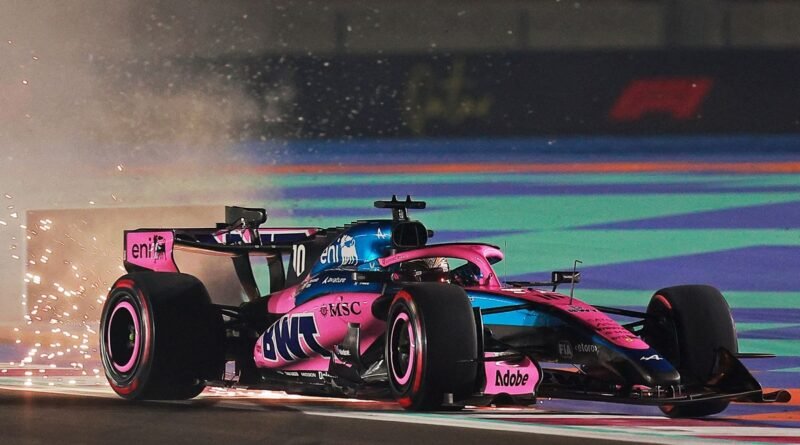
100% wear in 15 laps – F1’s tyre challenges in Qatar far more extreme than Pirelli expected
Every year, the Lusail International Circuit represents the biggest challenge on the Formula 1 calendar for its sole tyre supplier, Pirelli. It is precisely for that reason that a maximum stint length is once again in place this season, with the limit this time set at 27 laps per set of tyres.
The latter was based on Pirelli’s pre-event simulations, but in practice, the situation is proving even more extreme than expected, as Pirelli’s chief engineer Simone Berra explained.
“The point is that the graining level and the wear level are higher than what we expected pre-event. It’s quite impressive, the surprises that this circuit gives us every time we come here,” Berra smiled.
“What we have noticed is that during the high fuel running, the graining is on all three compounds, C3, C2 and C1. C1 is slightly more resilient in terms of mechanical resistance and the graining level is slightly reduced, while on C2 and C3 the graining level is moderate to heavy.
“That is accelerating the wear, mainly in two regions: the TWI 2 and 3 area, so basically towards the inside shoulder of the tyre, and then on the very outside shoulder of the tyre as well. We have two points of high wear and we have seen cases of 100% wear already during the high fuel running after 15 laps.”
Those cases of extreme localised wear occurred well before the prescribed 27-lap limit, meaning Pirelli is evaluating whether that limit needs to be reduced further. However, the answer is not necessarily yes, given that, in addition to the wear, tyre degradation is also proving higher than expected.
“We are evaluating all the sets that we have selected from FP1 and FP2. We are going to check them, to section them, and obviously if there is no integrity issue, we will keep the 27 laps. We know that the graining level will reduce for the race and the teams will do much more management to extend the stint length,” Berra explained.
“So, if they don’t induce any increase in terms of integrity issues, then we can keep the 27 laps. But it’s an analysis that is ongoing in our laboratory, so we are going to understand if we continue with 27 or not.”
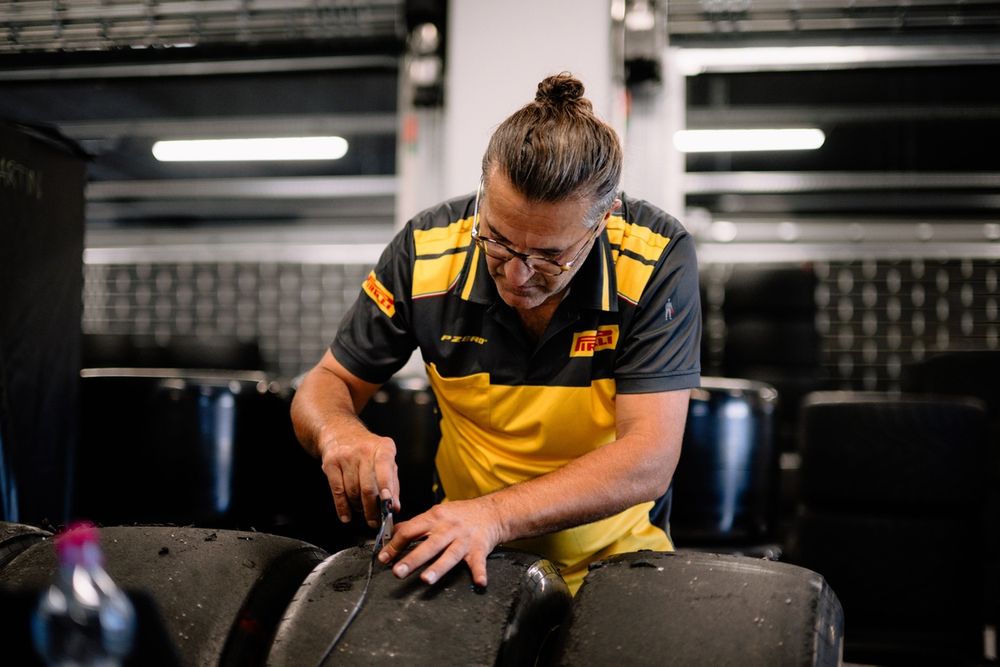
Pirelli team
Photo by: Pirelli
Higher degradation could make the existing limit less of a concern for Pirelli, as Berra does not expect teams to push right up to the permitted limit of 27 laps per set. With drivers losing a considerable amount of time per lap due to the high degradation, it could be more beneficial to pit earlier.
“It’s true what you said, so the degradation is higher than what we expected pre-event. And I think this will force the teams to stop earlier,” Berra said when asked about the degradation factor by Motorsport.com.
“I don’t think it’s really powerful at the moment, looking at the last analysis we have done, to do a 27-lap stint. Because if you extend for so long, there will be a clear drop in performance of 0.2 seconds per lap, and that forces you to take a new tyre and stop earlier. So basically you can divide the race into three more balanced stints instead of having 27, 27 and 3 laps.”
The latter is, of course, still a risk if there is an early safety car, as was the case last year. But even in that scenario, Berra does not expect to see 27-lap stints, but rather a three-stop strategy.
“Yes, correct. From our simulation, the optimum strategy will be 19, 19, 19. A safety car can even force them towards three stops in the end. One for the safety car and two later, instead of just one.”
The tyre pressure dilemma

Gabriel Bortoleto, Audi F1 Team
Photo by: Guido De Bortoli / LAT Images via Getty Images
In addition to the extremely high wear and the maximum stint length, there is another tyre-related talking point in the paddock: the extremely high tyre pressures. For the front tyres, the minimum pressure has been set at 29psi, the highest of the entire season.
Nevertheless, this is also still being evaluated, as the large amount of gravel on the track has quite literally left its mark on the tyres.
“We have noticed gravel cuts in the tyres. We’ve seen multiple drivers going off the track and bringing a lot of gravel onto the race line. We’ve seen some of those cuts quite deep into the construction,” Berra revealed.
“There was also a red flag due to this and it’s something that, on a circuit like this, it’s an additional variable that can create some attention from our side in terms of punctures, etc.”
In practical terms, this means Pirelli is also assessing whether the tyre pressures need to be increased even further, which would take them to a record high in the modern F1 era.
“We are evaluating all the variables and, if necessary, we will increase the pressure as well.”
However, Pirelli would prefer not to increase the tyre pressures, as doing so could exacerbate the graining and localised wear.
“We are almost running 30psi, so you basically localise it. You reduce the contact patch of the tyre and you localise the wear on a single point, basically,” Berra explained.
Those points are currently TWI 2, TWI 3 and TWI 6. TWI stands for tread wear indicator, with 2, 3 and 6 located towards the shoulders of the tyre. Increasing tyre pressure further would reduce the contact patch, potentially concentrating wear over a smaller area and shifting it towards the centre of the tyre.
“That’s why I wouldn’t increase the pressure, if possible. But if we have to do it for integrity reasons, then we’re obviously going to evaluate it. If you continue to increase the pressure, you move the graining more inboard, more towards the centre. And TWI 6 is under pressure anyway due to the high loads anyway, so basically you have high lateral loads and you stress this part of the tyre a lot.”
As Berra summed it up: “Surprise after surprise after surprise.”
We want your opinion!
What would you like to see on Motorsport.com?
– The Motorsport.com Team