
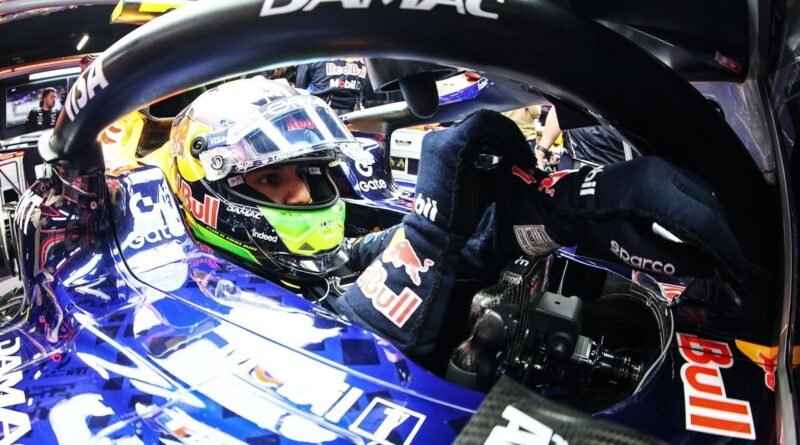
Isack Hadjar frustrated – What really happened on Red Bull’s team radio in Las Vegas
Isack Hadjar started Formula 1’s Las Vegas Grand Prix from fourth on the grid, and by lap four he had already found himself running second, right behind Red Bull team-mate Max Verstappen.
And given that the grand prix had turned into what can only be described as a slipstreaming battle of the kind normally associated with track cycling, it was almost inevitable that Hadjar would sooner or later have a go at taking the lead.
But a reminder from his race engineer Richard Wood was not long in coming. The priority, Wood explained, was to avoid losing time as a team. Red Bull needed to build a gap to George Russell, rather than waste precious seconds fighting among themselves. And Hadjar, certainly no stranger to self-confidence but ultimately a loyal Red Bull team player, complied.
Eventually, he found himself alongside Verstappen again on the long straight towards Turn 14. But the Dutchman had no intention of surrendering the lead without a fight. “Can he stop defending? Otherwise I just gotta lose time,” Hadjar complained over the radio. Wood, however, stuck to the plan they had already agreed upon: “Team request is to defend against George, otherwise we will be yo-yoing.”
At that point, Russell was the closest pursuer of the Red Bull Express at the front, with the trio merrily swapping positions. On one occasion, Russell even managed to overtake both Red Bulls simultaneously, only to find himself back in third place two or three corners later. In Las Vegas, slipstreaming and energy management were powerful weapons. More powerful, in fact, than outright speed.
Hadjar’s radio messages made it clear that, from a team perspective, he would have preferred something resembling a rotating paceline in cycling over conventional formation driving: a group of riders works together by constantly rotating the lead, allowing each member to benefit from the slipstream and enabling the group as a whole to travel faster than an individual rider could manage alone.
But Red Bull, apparently caught somewhat off guard by the peculiar dynamics of the race, did not seem particularly interested in Hadjar’s proposal. The idea of sharing the lead in order to open up a gap to Russell was not even discussed with Verstappen. At least, there is no corresponding question to be heard on the Dutchman’s official onboard radio feed.

Max Verstappen, Red Bull Racing, Isack Hadjar, Red Bull Racing
Photo by: Guido De Bortoli / LAT Images via Getty Images
Eventually, Hadjar had had enough. “No, look, I’m gonna give you an example right now. Look at what’s gonna happen,” he radioed. And at precisely that moment, rather than deliberately lifting off the throttle early to avoid attacking Verstappen into Turn 14, he kept his foot down. The result was quite spectacular. Hadjar sailed past his team-mate by several metres and into the lead. Then, ever the team player, he backed off again and allowed Verstappen to reclaim first place before the corner.
But he had made his point. “I can’t. On the straight, there’s too big of a difference. It’s harder than you think. I’m not lying.”
Hadjar argued that the two Red Bulls would be faster overall if he were allowed to overtake Verstappen, only for Verstappen to retake the position on the following lap. Rather than unnecessarily slowing one another down, they could use the enormous slipstream advantage to maintain their collective pace. It was a straightforward proposition: take turns leading, benefit from each other’s slipstream, and keep moving forward as quickly as possible.
All of this happened on lap eight. And almost as if the race itself were determined to vindicate Hadjar’s argument, Red Bull’s 1-2 formation was gone just one lap later. The team had failed to shake off Russell.
Asked afterwards whether Red Bull might actually have compromised its own chances by insisting on protecting Verstappen’s lead at all costs, team principal Laurent Mekies acknowledged that Hadjar had made a legitimate point.
“Fair points,” Mekies admitted. “I think the first thing to say is that as much as we all knew it was an energy-poor track and we were all expecting a lot of gaming in the race, as much as we saw yesterday the much bigger than expected slipstream effect, I think none of us were going to the race thinking that we’ll have two overtaking per lap for 50 laps.” In other words, even Red Bull had underestimated just how extreme the slipstreaming effect would prove to be.
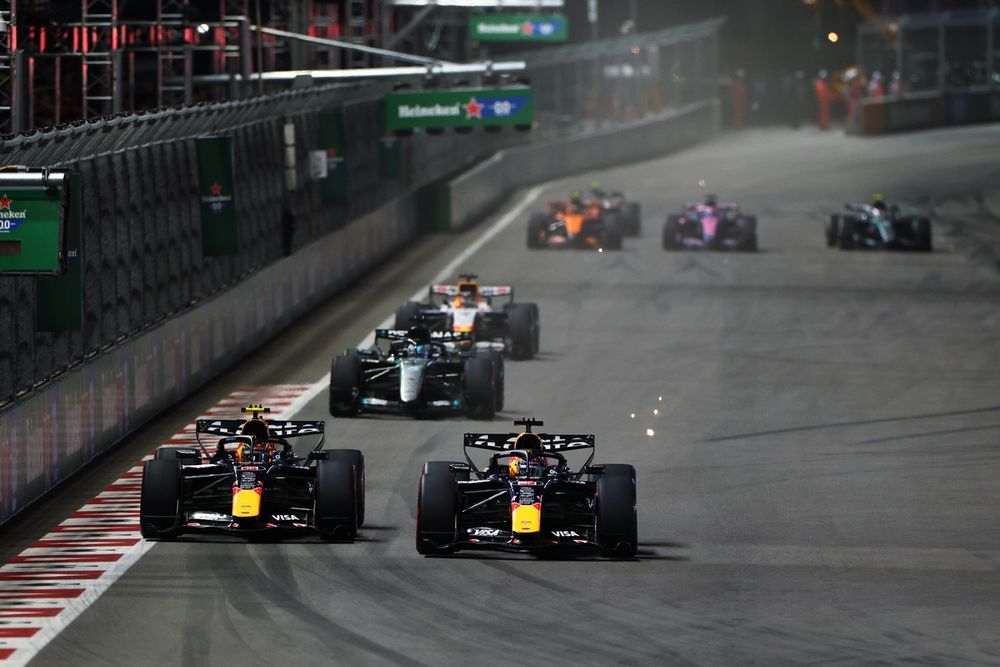
Max Verstappen, Red Bull Racing, Isack Hadjar, Red Bull Racing
Photo by: Mark Thompson / Getty Images
“So why am I saying that? Because I truly think that in the first few laps we all had to adapt on what is the new reality for this race.” That explains why Red Bull’s strategists were reluctant to embrace Hadjar’s approach. “And we didn’t feel that swapping the car every lap would be the fastest way to go to the end. We will never know the answer. And we felt it was certainly better if both cars could help each other defend on the positions behind.”
With the benefit of a few hours’ hindsight, Mekies was no longer quite as certain about that judgement as he had been during the race. After all, nobody could say for sure whether Hadjar’s rotating-lead strategy might have enabled the two Red Bulls to escape from Russell.
Eventually, the issue resolved itself when Hadjar’s front wing suddenly broke, effectively ending the 22-year-old’s victory hopes. Little wonder, then, that his response was somewhat irritated when the subject of the team radio discussion was raised after the race: “There was no misunderstanding. I wasn’t trying to create a mess. It’s just using my brain.”
Whether intentionally or otherwise, that could certainly be interpreted as a verbal dig at the Red Bull pitwall. Hadjar explained the thinking behind his approach: “What I’m trying to do, because I understand racing, is you need to go as fast as possible. It doesn’t matter. You need to just go, overtake, get overtaken back, overtake. You just need to keep going. Because if I hold back, then the guy behind and the car behind is just going to overtake me because there’s 40km/h difference.”
The Frenchman was convinced that Red Bull had simply underestimated the extraordinary influence of the slipstream: “I think they just didn’t realise how big the tow games were. It’s not like I can just sit behind and if I do that then George goes through. It’s either I go for it and we both go flat out, passing, re-passing. That was the fastest race. If you tell me to sit behind and just give up the position then it’s not going to work for me.”
For all his frustration, however, Hadjar may actually have done his standing within Red Bull a great deal of good in Las Vegas. First, he once again demonstrated that he is the first team-mate in a long time capable of operating, at least for certain stretches of a race, in something approaching Verstappen’s performance territory. And second, any lingering suspicions that he might simply be acting selfishly, using clever radio messages to manoeuvre himself past Verstappen, should now have been put to rest.
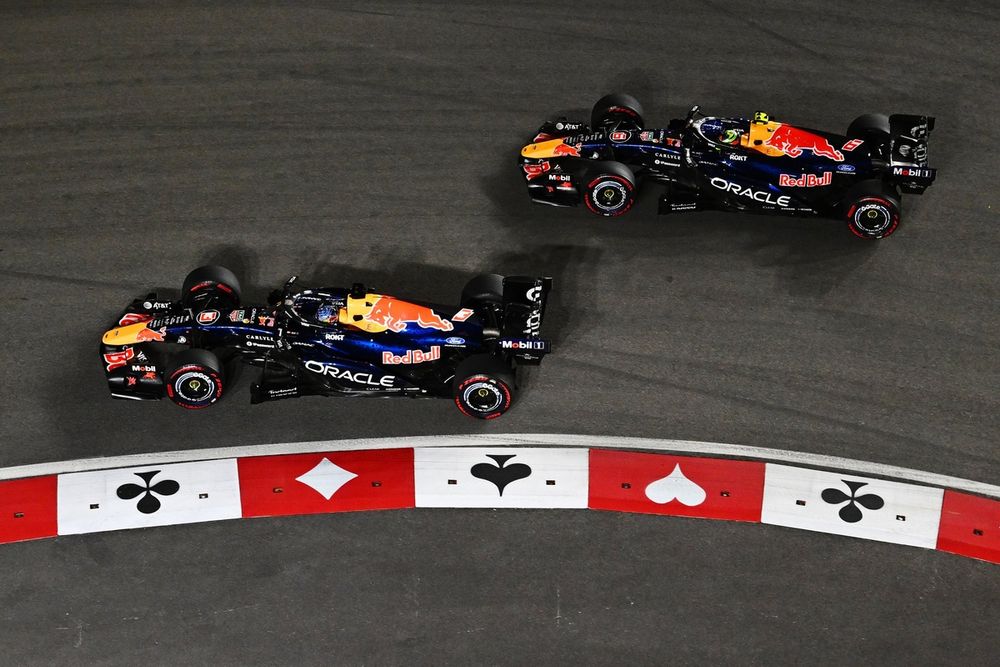
Max Verstappen, Red Bull Racing, Isack Hadjar, Red Bull Racing
Photo by: Manuel Eletto
Hadjar’s approach demonstrated that he was thinking about the team’s overall performance rather than merely his own position. This sort of behaviour builds trust, And Mekies was full of praise for precisely that: “I think he did very, very good, honestly.
“He was there on merit, he was there because he had the pace, he was there because he was understanding very well the defensive, offensive manoeuvres, and that’s the best situation possible for us. And he also understood well when we asked him to keep the battles for later and to concentrate on not getting caught by the guys behind.”
For Mekies, the incident was further evidence of Hadjar’s development over the course of the season: “We have been saying so many times this year, he’s improving race after race. That’s also what we see another time today. He was P4 on the grid, P1, P2 on the road. Last weekend, we did P2, P3, and we had to swap the cars last weekend. So it’s good news.”
Beyond his outright pace, the Red Bull team principal highlighted another area in which Hadjar has been making substantial progress: emotional control. “Isack is a very intelligent individual, and it’s very difficult for us non-drivers to assess what drivers have to deal with in terms of management of their emotions when they are in the car,” he said.
“And he recognised that, he knows very well that managing these emotions better gives him lap time in the car and lap time outside of the car in terms of the quality of the communication with his engineers. And as you pointed out, he made very, very big steps in the last two, three races. And we see even more potential moving forward.”
“So he’s exchanging better and better with his engineering crew, and he’s executing stronger when he’s able to keep his emotions under control. And we are very happy with the progress he’s making.”
We want your opinion!
What would you like to see on Motorsport.com?
– The Motorsport.com Team