Nicholas Hoult Filmed 2 Different Endings for His ‘How to Rob a Bank’ Character
Summary
- Collider’s Steve Weintraub talks with the cast of How to Rob a Bank.
- Nicholas Hoult reveals why he had no idea how his character’s story ended while filming.
- Hoult, John C. Reilly, Anna Sawai, and Rhenzy Feliz discuss filming different versions of scenes, their tight camaraderie, and how they prep before filming.
In David Leitch’s new heist thriller, How to Rob a Bank, a group of bank robbers take matters into their own hands when a flawed system fails them. Starring Nicholas Hoult, Pete Davidson, John C. Reilly, Zoë Kravitz, Anna Sawai, and Rhenzy Feliz, the movie takes audiences on a high-octane ride using 35mm film intertwined with attention-grabbing YouTube footage for a final cut even the cast didn’t see coming.
How to Rob a Bank follows an anonymous YouTuber, “The Wolf” (Hoult), and a group of bank robbers — Davidson, Sawai, and Feliz — who post their capers on the internet. As they continue to see success online, an FBI agent (Reilly) hires a hacker on house arrest (Kravitz) to help put an end to their escapades.
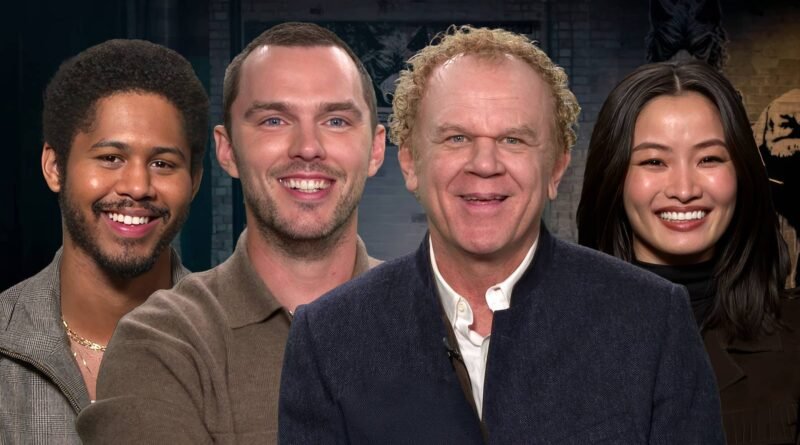
In this interview, Collider’s Steve Weintraub talks with Hoult, Reilly, Sawai, and Feliz to discuss their approach to the material, working with Leitch on different versions of their scenes, and how the film’s surprising perspectives came together in the end. Check out the full conversation in the video above, with a transcript provided below.
Nicholas Hoult Reveals They Filmed Multiple Versions of His Ending
“There were lots of undecided things.”

COLLIDER: John, I’m going to start with you.
JOHN C. REILLY: I wonder why.
Yeah, I was just curious how you feel when someone is wearing a bootleg T-shirt of your face during an interview for your new movie.
REILLY: I’m still getting used to it. Yeah. I’ll let you know at the end of the interview.
I wore this for something I did with Will Ferrell, and I handed him a dollar to give him a residual payment. I would do the same for you, but we are virtual.
REILLY: You know, I would have done that movie for free. It was a joyful experience. But how about How to Rob a Bank?
I really want to start with congrats on the movie. I think the film does a great job of capturing the anger that so many of us feel about what’s going on. But before I get into the film, I’m doing a supercut of everyone I’m interviewing right now, and I’m asking everyone where they like to sit in a movie theater.
REILLY: I like to sit on the aisle. First seat on the aisle, usually a little bit over to the right, about halfway down.
NICHOLAS HOULT: That’s pretty close to where I like to sit.
RHENZY FELIZ: You’re an aisle guy, too?
HOULT: I’m not necessarily right on the aisle, but close enough that if I have to get up, I don’t have to go right past everyone.
FELIZ: I try to do everything possible to never have to get up through the movie, so I will do whatever I gotta do. I like to go middle. Middle, but close-ish. Not too close, but not middle-middle. Closer than middle, but not all the way forward.
HOULT: Which row? A? C?
FELIZ: Normally, it’s G. At the Lincoln Center, it’s G. It’s right in the middle of G. So that’s, like, six, or something.
ANNA SAWAI: [Laughs] I’m in the middle but towards the back. But I like to be in the center.
HOULT: Does anybody ever say, like, front left?
I’ve had people say they actually like being the first or second row. I think they’re insane, but by all means. That’s the great thing about this question is you get all sorts of answers.
REILLY: Well, there’s always a seat available if it gets crowded, because most people don’t pick that front row.
Jumping into why I get to talk to you guys, like I said, I really do think that this captures a lot of the anger that so many of us feel, and I’m just curious, how did the finished film actually compare to the script you read and what David [Leitch] told you about it going in?
SAWAI: I feel like when I read it, I was reading with Emmy in mind, and so everything kind of felt really heavy. But I was surprised at how entertaining and fun it was, because I forgot that it was more of that in the film.
FELIZ: I guess maybe, yeah, a similar thing where the perspective was from the robbers’ side, and then when I watched the final version of it, it felt like so much more of the perspective was sort of looking at us instead of it coming from us. And I think I also felt more mysterious in the edit when I watched the movie than I felt when I was making it. I felt the audience would maybe know more about us, and when I watched, I was like, “Oh, we’re a little bit out of reach, just slightly.” Like, it’s the chase, which I think actually, it’s better than what I had thought up in my head when I was reading the script.
HOULT: Seeing the film was exciting because, like Rhenzy was saying, all of John and Zoë [Kravitz]’s part of the movie we weren’t present for. So, to see how they developed those characters and that side of the story was really exciting and fun to watch.
Then these robberies, because they’re so different, the film parts of this are so grounded and lived in and very beautifully shot, and then this content that they create is so fast. The way that that was shot with these POV cameras and lenses attached to us and the stunt team itself, it was so frantic. So to see how those things combined, I just think David did a really creative, wonderful job mixing those mediums in many ways.
But also, he’s so open to ideas and trying things that even whether my character died or didn’t die wasn’t decided fully. So we shot both versions of that towards the end of the movie, and it was only when he was done editing and stuff that he made the final decision on those things. So, it’s kind of a nice surprise seeing the movie for me because there were lots of undecided things. [Laughs]
REILLY: I think playing a character in a movie is similar to life, in that everyone walks through life like they’re the lead character. You know, your experiences, the way you’re seeing your life. And so I thought the movie was about a guy trying to catch some bank robbers. And then you see all this is social media content that’s part of the movie and what’s actually happening in the heist and everything. So yeah, like Nick was just saying, it’s always a delight to see the parts of the movie that you were not present for when it was being filmed.
Nicholas Hoult Gained a New Respect for YouTubers Making ‘How to Rob a Bank’
In the movie, Hoult plays an anonymous creator called “The Wolf.”

Nick, I really think that the YouTube stuff that’s in this is just so well done. I’m curious if, as you were filming it, did you gain a newfound respect for content creators being able to talk to the camera and pull you in?
HOULT: I did, because it’s so complicated, the levels of it. Plus, I think it’s a personality thing, which I don’t have. So to be able to be that presenter, but also to keep people engaged, you’re vying for attention and clicks and subscribes and all these sorts of things. So, it’s really fascinating.
This team is obviously really great at it and has tapped into a nerve. And like you were saying, people are angry about many different things, so there’s this element of creating a voice for people that feel like they aren’t being heard is a special thing. But yeah, it gave me a whole new level of respect because it’s not something I could do — particularly while I was robbing banks.
100%. One of the things I love learning about is the behind-the-scenes, the making of a movie, and I love learning shit that you cannot find on Wikipedia or in the press notes. For soon-to-be fans of the film, is there anything that you think would be cool to learn or exciting or unique about actually making this film?
REILLY: The guns had blanks in them. They weren’t actual, real bullets.
HOULT: Every sixth one was a real bullet, and they wouldn’t tell us. [Laughs]
One of the things I’m so curious about is when you guys are making a movie like this, the four of you are never working together. This is like your first day, when you’re doing press, that you’re with each other. What have you learned about each other through a day of doing press?
REILLY: I’ve learned if there’s a pause, I’ll start talking. I’ve learned that about myself.
HOULT: I’ve learned to pause so that John will start talking. No, actually, when we all got to Pittsburgh, us four were the first four people to hang out. We went to go to dinner together. So, this is like the reunion of the OG core group.
REILLY: Yeah, and my first day was the interrogations, so I actually spent the day with everybody the very first day of shooting.
FELIZ: We’re all great friends. We’ve done roller coaster rides. We’ve done pickle rides. We’ve done it all. We’re a tight-knit unit.
HOULT: All the rides.
That’s only if you still have a text chain going.
FELIZ: Well, actually, for a while there, we did, and it was one of the highlights of my day, actually. We gotta fire that back up again.
John C. Reilly Reveals How He Prepares for Emotionally Demanding Scenes
The cast discuss their prep before stepping on set.

I love learning about how actors get ready for a role or a big scene, so when you’re making a film like this or filming in general, and you have a big scene coming up on a Monday, how are you getting ready for that? Is it in the days leading up to it, or are you always thinking about it weeks in advance? I’m just fascinated by how actors get ready for a role or a big scene, because it’s something that I could never do myself.
REILLY: Well, there’s the learning of dialogue, of course, memorizing your lines and all that stuff, but I find myself really making sure that I understand the emotional shifts in the scene — when things change, when does the temperature in the room change when someone says this or that — and then you kind of compare notes with the director when you get there. You know, you give your take on it.
I think every actor has their own process, actually, very individually, but my thing is I always try to leave enough space so that in case my interpretation is not what the director wants, that I can pivot, that I’m not set in something so much that I can’t do what they want me to do.
HOULT: I try not to think of it as a big scene if it’s a big scene. Does that make sense? Because if you’re like, “Oh, this is a big scene,” then you’re probably going to intimidate yourself into not being loose and free with it. So I try and prepare as much as possible, but then also remember that it’s a culmination of all the scenes and all the work that make the difference, not necessarily this one pivotal thing, so you can go in there and approach it with a sense of ease and have fun with it, I guess.
FELIZ: That’s something I still got to learn. I feel like I try not to think of it as such a big thing, but I find myself…
HOULT: Well, I still do it. I’m still like, “It’s a big one!”
FELIZ: Yeah, I know the day it’s coming up. But I think what you said was crucial. You guys actually both said it. You prepare, and you try to figure out exactly what the heck’s going on with your character in the moment, and all the lines, and you know everything, hopefully, so well that you can sort of feel the freedom to go in and try to find something natural and fun and spontaneous amidst all the preparation.
I think the only times I’ve ever felt comfortable going into big days is when I feel like I know so much about what’s going on in the moment with the character, with the scene and the movie in that moment that I’m open to so many different kinds of things happening on the day. But I’ve been guilty of maybe not being prepared as much as I should have on some days, and that’s when I go into it the most nervous and the most in my head about things.
SAWAI: Also, sometimes they can change the script the day before. So, you do as much preparation as you can, like they said, but yeah, you just have to go in and do what you can.
How to Rob a Bank opens in theaters on November 13.

- Release Date
-
November 13, 2026
- Runtime
-
122 Minutes