The 7 Best Martial Arts Movies Released Since 2020, Ranked
I have watched perfectly choreographed fights that I cannot remember a single thing about. Beautiful kicks, elaborate camera movements, somebody getting thrown through an expensive-looking window. Five minutes later, nothing. Meanwhile, I can remember the exact expression on a character’s face before a fight from a movie I watched years ago. I’ve started to suspect that my favorite martial arts sequences are actually acting scenes which teach you something about the character instead.
That’s why Bruce Lee remains my favorite. All doors closed and enemies in the arena knocked down? Bruce Lee would sit down peacefully because there’s nothing to be done at the moment, so save your energy. And there is something wonderful about watching filmmakers who understand that distinction. These are the six best martial arts movies released since 2020.
7
‘Kill’ (2023)

There is something wonderfully audacious about setting practically an entire action movie on a moving train and then making that train feel increasingly smaller. Kill follows Indian Army commando Amrit (Lakshya), who boards a train with his fellow soldier Viresh (Abhishek Chauhan) to reunite with Tulika (Tanya Maniktala), the woman he loves. When a large gang of armed thieves attacks the passengers, Amrit intervenes, bringing himself into direct conflict with the vicious Fani (Raghav Juyal). What begins as a desperate attempt to protect innocent people eventually becomes something far more personal.
The moment the film’s title finally appears is when you realize director Nikhil Nagesh Bhat has been holding back. Amrit’s fighting undergoes a terrifying transformation, with the narrow corridors and cramped compartments becoming instruments of destruction. Lakshya is astonishingly convincing throughout, but Juyal deserves enormous credit for giving the violence an antagonist who remains frighteningly unpredictable. Their conflict develops such personal bitterness that every subsequent confrontation becomes harder to endure. I particularly admire how relentlessly the film exploits its setting. There is nowhere comfortable to retreat, and the exhaustion becomes impossible to ignore.
6
‘The Paper Tigers’ (2020)

The Paper Tigers has one of my favorite premises for a martial arts comedy because its protagonists must somehow recover abilities that have been neglected for decades while confronting the people they have become. Danny (Alain Uy), Hing (Ron Yuan), and Jim (Mykel Shannon Jenkins) were once inseparable kung fu prodigies who trained under the same beloved master. Twenty-five years later, their friendship has deteriorated, their bodies have aged, and the martial arts barely feature in their everyday lives. Then their former teacher dies under suspicious circumstances, forcing the three men to reunite and investigate what happened.
Watching the former champions struggle against younger fighters is hilarious, particularly when enthusiasm considerably exceeds physical capability. Eventually, however, the comedy reveals genuine regret. Danny has responsibilities as a father, Hing and Jim have their own disappointments, and their master’s death has exposed how thoroughly they abandoned something they once treasured. The climactic confrontation becomes unexpectedly satisfying because Danny finally remembers that being a martial artist involves considerably more than possessing extraordinary physical abilities.
5
‘Monkey Man’ (2024)

The first thing Dev Patel does in Monkey Man is get beaten up. His character, known as Kid, earns money fighting in an underground club while wearing a monkey mask, deliberately absorbing punishment as he prepares to infiltrate the criminal establishment responsible for destroying his childhood. His ultimate targets are corrupt police officer Rana Singh (Sikandar Kher) and the influential spiritual leader Baba Shakti (Makarand Deshpande). Kid intends to avenge his mother’s murder, although his initial attempt reveals how woefully unprepared he is for the people protecting his enemies.
Patel also directed the film, and I love his willingness to make his own character look genuinely desperate. That disastrous first attempt leaves Kid needing recovery and further training, eventually finding refuge among a hijra community that helps him rebuild. Their involvement gives his revenge a wider emotional purpose, and the subsequent fighting becomes considerably more controlled. Then comes that outrageous elevator encounter involving a knife and some exceptionally inventive improvisation. Patel throws himself into the action with extraordinary commitment, frequently looking physically devastated. His determination to make every confrontation hurt is precisely what separates this from a routine revenge spectacle.
4
‘The Shadow Strays’ (2024)

Seventeen-year-old assassin 13 (Aurora Ribero) has been conditioned to kill without hesitation. When a mission goes wrong, her organization suspends her and sends her to Jakarta, where she befriends Monji (Ali Fikry), a young boy whose mother dies under suspicious circumstances. His subsequent disappearance sends 13 into a criminal underworld populated by traffickers, corrupt police officers, and powerful political figures. Rescuing him will require betraying the organization that trained her, including her formidable mentor Umbra (Hana Malasan).
I would recommend The Shadow Strays to practically anybody who appreciates extraordinarily aggressive action choreography. It’s directed by Timo Tjahjanto and the film unleashes an astonishing collection of confrontations, with 13 demonstrating increasingly creative methods of dismantling entire groups of armed opponents. But the relationship with Umbra gives the eventual violence its most interesting dimension. This woman trained 13, protected her, and helped turn her into a weapon. Now her student has developed precisely the emotional independence their organization wanted to prevent. Their eventual confrontation is spectacular, although the hesitation between attacks says considerably more about their relationship than the weapons ever could.
3
‘Everything Everywhere All at Once’ (2022)

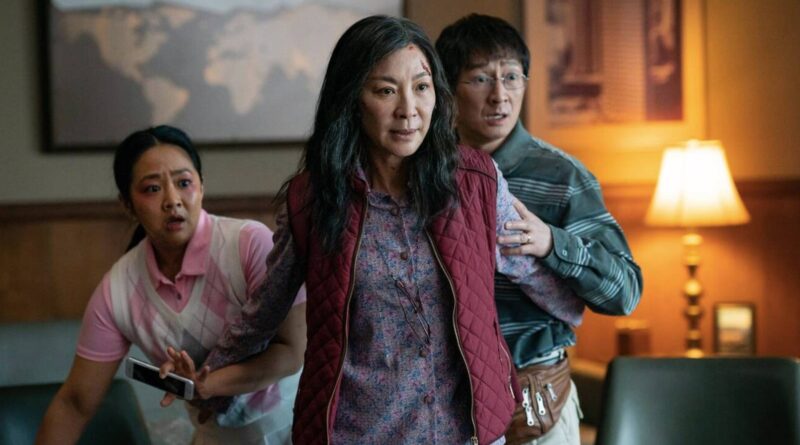
Evelyn Wang (Michelle Yeoh) is drowning in tax problems, family responsibilities, and the exhausting consequences of a life that looks nothing like the one she once imagined. Then she discovers that alternate universes exist and that versions of herself possess extraordinary abilities she can temporarily access. Everything Everywhere All at Once sends Evelyn across increasingly ridiculous realities while an immensely powerful threat jeopardizes existence itself. Unfortunately, the person at the center of that threat is connected to the relationship Evelyn has been neglecting most painfully.
I could recommend this movie based entirely on Waymond (Ke Huy Quan) demolishing security guards with his fanny pack. Or the wonderfully ridiculous IRS fight involving an extremely unfortunate trophy. Directors Daniel Kwan and Daniel Scheinert clearly have tremendous affection for classic Hong Kong action choreography, and Yeoh makes their most outrageous ideas look completely natural. Yet the scene I love most is Waymond explaining that kindness is how he fights. Suddenly, all those spectacular confrontations acquire another dimension. Evelyn has spent the movie borrowing other people’s abilities, desperately searching for some version of herself who made better decisions. The person who can actually help her has been standing beside her all along.
2
‘Twilight of the Warriors: Walled In’ (2024)

I would happily spend another entire movie wandering around this version of Kowloon Walled City. Twilight of the Warriors: Walled In follows Chan Lok-kwan (Raymond Lam), a desperate young refugee who escapes a criminal gang and seeks shelter inside the notorious settlement. There, he encounters Cyclone (Louis Koo), a powerful but surprisingly compassionate local leader. What Chan discovers is an entire community operating according to its own rules, offering him friendship and something resembling a home before a violent struggle threatens everything.
The sense of place is magnificent. Director Soi Cheang fills the narrow corridors with extraordinary physical confrontations while allowing enough ordinary life to make the settlement worth defending. Cyclone’s combination of quiet authority and devastating fighting ability is wonderful, and Sammo Hung brings considerable presence to the criminal conflict. Then there is King (Philip Ng), whose frightening abilities push the younger fighters toward increasingly desperate methods. The action becomes wonderfully outrageous, yet I find myself caring most about Chan and the friendships he develops. By the time the Walled City comes under attack, protecting those crowded streets feels intensely personal. You understand exactly why these people would risk their lives for a place outsiders barely understand.
1
‘Rurouni Kenshin: The Final’ (2021)

Rurouni Kenshin: The Final confronts Kenshin Himura (Takeru Satoh) with Yukishiro Enishi (Mackenyu), a man determined to avenge the death of his sister Tomoe (Kasumi Arimura), whom Kenshin once loved. Kenshin used to be an extraordinarily dangerous political assassin. He has since committed himself to protecting people without killing, carrying a reverse-blade sword as a constant reminder of that promise. Enishi, on the other hand, launches devastating attacks against Kenshin’s friends and the surrounding city, intending to make the former assassin experience the suffering he has carried for years.
The fighting is ridiculous in the most complimentary sense imaginable. Keishi Ōtomo returned to direct this installment, and the fluidity of Satoh’s movements remains almost impossible to believe. His unexpected collaboration with former enemy Seta Sōjirō (Ryunosuke Kamiki) is a particular delight, with their synchronized movements showcasing two extraordinarily gifted swordsmen. But Kenshin’s confrontation with Enishi is the scene I would show somebody who believes martial arts movies cannot deliver substantial character drama.