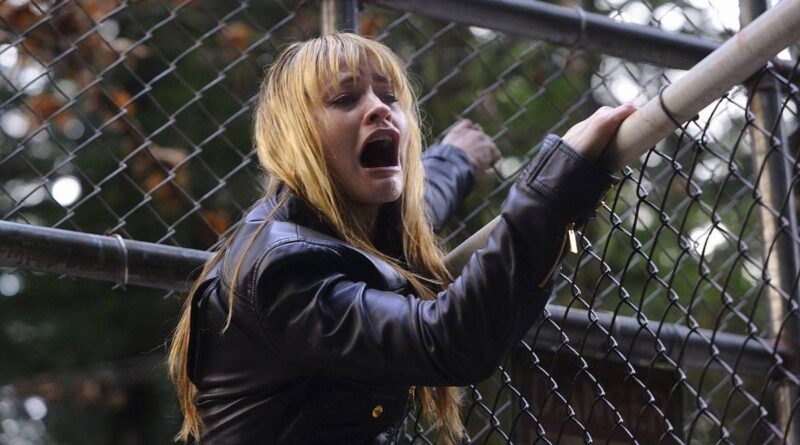
Seventeen years after its CBS premiere, Harper’s Island remains a bloody pick for Halloween viewing. Created by Ari Schlossberg, the 2009 limited series packs a complete murder mystery into 13 episodes, giving viewers time to know its wedding guests before cutting them down. Its blend of horror and mystery makes every death do double duty: another gruesome scare, and another reason to reconsider who might be responsible.
Focusing on a group of people isolated on an island, it’s immediately reminiscent of one of the mystery genre’s most famous works, the novel, And Then There Were None, by Agatha Christie, which pioneered what a terrifying experience getting stuck on an island with a killer could be. This book became a prolific manual for the genre after its release in 1939, perfectly portraying the elements necessary for a great mystery (though, noticeably, it skimped on horror). This is common for any attempt at genre fusion, as often creators put more emphasis on one aspect of their creation while neglecting the other. Not Harper’s Island, though. This series, with its inventive mystery, ominous scares, and seemingly endless amounts of visceral bloodshed, shows the best parts of the mystery and horror genres and uses both to create a horrifying story.
‘Harper’s Island’ Is the Perfect Place for Terror
Before Harper’s Island mastered this fusion, Christie was the unrivaled expert at how to make mysteries terrifying. This legendary writer is known for her nail-biting stories, setting herself apart by exploring new depths of the genre that similar writers at the time didn’t dare to. While “whodunits” (stories where the core mystery is a secret killer’s identity) have always existed, Christie made the threat terrifying by trapping her characters together and turning their suspicions against one another.
Collider Exclusive · Horror Survival Quiz Which Horror Villain Do You Have the Best Chance of Surviving? Jason Voorhees · Michael Myers · Freddy Krueger · Pennywise · Chucky
Five killers. Five completely different ways to die — if you’re not smart enough, fast enough, or self-aware enough to avoid it. Only one of them is the villain your particular set of instincts gives you a fighting chance against. Eight questions will figure out which one.
🏕️Jason
🔪Michael
💤Freddy
🎈Pennywise
🪆Chucky
01
Something feels wrong. You can’t explain it — you just know. What do you do? First instincts are the difference between the survivor and the first act casualty.
02
Where are you most likely to find yourself when things go wrong? Setting is everything in horror. Where you are determines which rules apply.
03
What is your most reliable survival asset? Every survivor has a quality the villain didn’t account for. What’s yours?
04
What kind of fear is hardest for you to fight through? Knowing your weakness is the first step to not dying because of it.
05
You’re with a group when things start going wrong. What’s your role? Horror movies are brutally clear about who survives group situations and who doesn’t.
06
What’s the horror movie mistake you’re most likely to make? Honest self-assessment is a survival skill. Denial is not.
07
What’s your best weapon against something that can’t be stopped by conventional means? Every horror villain has a weakness. The survivors are always the ones who find it.
08
It’s the final scene. You’re the last one standing. How did you make it? The final survivor always has a reason. What’s yours?
Your Survival Odds Have Been Calculated Your Best Chance Is Against…
Your instincts, your strengths, and your particular way of thinking under pressure point to one villain you actually have a fighting chance against. Everyone else — good luck.
Camp Crystal Lake · Friday the 13th
Jason Voorhees
Jason is relentless, but he is also predictable — and that is the gap you would exploit.
He moves in straight lines toward his target. He doesn’t strategise, doesn’t adapt, doesn’t outsmart. He simply pursues.
Your ability to keep moving, use the environment, and resist the panic that freezes most victims gives you a genuine edge.
The Crystal Lake survivors were always the ones who stopped running in circles and started thinking about terrain, water, and distance.
You think like that. Which means Jason, for all his indestructibility, would face someone who simply refused to be where he expected.
Haddonfield, Illinois · Halloween
Michael Myers
Michael watches before he moves. He is patient, methodical, and almost impossible to detect — until it’s too late for anyone who isn’t paying close enough attention.
But you are paying attention. You notice the shape in the window, the car parked slightly wrong, the silence where there should be sound.
Michael’s power lies in the invisibility of ordinary suburbia — the fact that nothing ever looks wrong until it already is.
Your spatial awareness and instinct to map every room, every exit, and every shadow before you need them is precisely the quality Laurie Strode had.
You are not a victim waiting to happen. You are someone who already suspects something is wrong — and acts on it.
Elm Street · A Nightmare on Elm Street
Freddy Krueger
Freddy wins by getting inside your head — using your own fears, your own memories, your own subconscious as weapons against you. That strategy requires a target who can be destabilised.
You are harder to destabilise than most. You’ve faced uncomfortable truths about yourself and you haven’t looked away.
The survivors on Elm Street were always the ones who understood what was happening and chose to face it rather than flee from it.
Freddy’s greatest weakness is that his power evaporates in the presence of someone who refuses to give him the fear he feeds on.
Your psychological resilience — the ability to stay grounded when reality itself becomes unreliable — is exactly the quality that keeps you alive here.
Derry, Maine · It
Pennywise
Pennywise is ancient, shapeshifting, and feeds on terror — but it has one critical vulnerability: it cannot function against someone who genuinely stops being afraid of it.
The Losers Club didn’t survive because they were braver than everyone else. They survived because they faced their fears together, and faced them honestly.
You ask the questions others avoid. You look directly at what frightens you rather than turning away.
That directness — the refusal to let fear fester in the dark — is Pennywise’s worst nightmare.
It chose the wrong target when it chose you. You are exactly the kind of person whose fear tastes like nothing at all.
Chicago · Child’s Play
Chucky
Chucky’s greatest advantage is that nobody takes him seriously until it’s already too late. He exploits the gap between how something looks and what it actually is.
You don’t have that gap. You take threats seriously regardless of how they present — and you never make the mistake of underestimating something because of its size or appearance.
Chucky relies on surprise, on the delay between recognition and response. You close that delay faster than almost anyone.
Your instinct to treat every unfamiliar thing with appropriate scepticism — rather than dismissing it because it seems absurd — is the exact quality that keeps you breathing.
Against Chucky, not laughing is already winning. You are very good at not laughing.
The influence of her work is all over the modern horror genre, with legendary movies like Scream having the ongoing question of who’s behind the mask to add an unnerving sense of dread to the bloodshed on display. This wonder of who onscreen is the secret killer makes the scares more haunting, yet too often, these movies find their mystery overshadowed by attempts to frighten the audience. The question of the killer’s identity still exists, but the few clues they offer are so blatant or nonexistent that they don’t add any depth to the larger puzzle at play.
By being a limited series with an outstanding creative team, Harper’s Island doesn’t suffer from this issue. This chilling tale focuses on the impending wedding of lovebirds, Henry Dunn (Christopher Gorham) and Trish Wellington (Katie Cassidy), who make the ingenious decision to host their nuptials on the titular island (where a series of gruesome murders had occurred years before, because of course it did). This occasion brings together their friends, family, and potential enemies: a classic setup for an excellent mystery that constantly has viewers guessing who in this large cast is the secret murderer still plaguing the island. But while this is a somewhat obvious premise for both mysteries and horror, the series does something that very few in this genre do by granting each of these relationships the time they deserve. Harper’s Island gives each of its characters a complexity that characters in horror often lack, making audiences begin to genuinely care about everyone involved right before making it clear that none of them are safe.
One by One, They All Fall in ‘Harper’s Island’
Abby (Elaine Cassidy) and Henry (Christopher Gorham) in Harper’s IslandImage via CBS
While most horror projects spend some time fleshing out the significance of only a few core relationships, Harper’s Island imbues each character and their interactions with a distinct set of complicated, often very unhealthy dynamics. From ex-partners to toxic parents, each wedding party member is allowed shockingly genuine moments to make them compelling. Juggling such a large cast, it’s incredible that the series can endow these characters with unique personalities, only to horrify viewers as these people are cut down one by one.
The show makes it clear that despite its care for each character, it still follows the rules of mystery and horror, meaning that most people on display will eventually become just another body for the killer to cut through. It’s the care that Harper’s Island puts into presenting these eventual victims while still carrying through mystery elements that keep audiences guessing, making each death so devastating for everyone involved (and those watching through the screen).
From immolation and a harpoon through the chest to a sickeningly innovative way of using a boat’s motor, it’s surprising that the gore on this show was even allowed on network television. Any horror fans hoping for inventive murder methods will find them here, as each episode features the unseen killer using random nautical tools to cut down (almost) everyone at this wedding. Yet even with this rampant bloodshed, the series still makes time for its mystery; it doesn’t get distracted by the murder, instead using each one as another step to uncovering who the true killer is.
This adds another layer of nuance to the characters, as their heartache drives them to uncover the secrets at hand. These are some of the scariest moments of the show as, yes, the actual murders are petrifying in themselves, but Harper’s Island takes an agonizing amount of time to show the heartbreakingly authentic reactions of the other island dwellers once they realize that their loved ones have been murdered. They show each person mourning the dead, as the series commits to its own story, creating an unnerving, haunting display of gut-wrenching emotion—and, well, literal guts.
On ‘Harper’s Island’, Few Make It Out Alive
As with most limited series, it’s unfortunate that Harper’s Island‘s perfect fusion of horror and mystery was only on for 13 episodes. Yet even within such a short runtime, the program was able to spotlight so much gore, mystery, and an all-around fascinating plot that scared viewers as much as it drew them in deeper. By utilizing the authentic emotions of its large cast of characters (about 25 people, each acting beautifully), this show creates a realistic sense of camaraderie between them, bringing actual levity to their internal strife and showcasing the tangled connections between them.
Harper’s Island puts the necessary time in to make each character endearing, often just shortly before cutting them down and using their gruesome murders to emphasize how terrifying the unseen killer is (with a finale unveiling that is one of the most shocking that television has ever seen). It utilizes the saddening loss of these great personalities and the lingering unknown of their murderer to petrify viewers even more, creating an unsettling yet intriguing experience that will horrify all but make it impossible for anyone to stop watching.
Harper’s Island is available to purchase digitally on Amazon Video, Apple TV Store, and Fandango at Home in the U.S.