
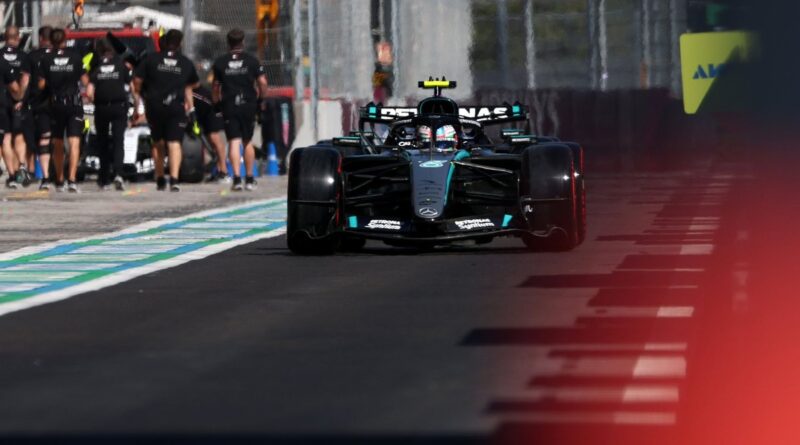
How Kimi Antonelli and Mercedes made their own luck in Madrid
There’s no doubt everything fell perfectly into place for Kimi Antonelli to win Formula 1’s Spanish Grand Prix.
The virtual safety car triggered by Lance Stroll’s retirement came at the perfect moment, changing the course of a race that, until that point, had seemed destined to end with victory for Lando Norris.
Having already passed the pitlane entry by the time the VSC was deployed, Norris had no chance to dive into the pits. Antonelli, on the other hand, managed to enter the pitlane at the last second, complete his stop and take the ‘virtual’ lead of the grand prix, slotting in just behind Charles Leclerc, who had yet to pit.
While luck played its part, there is a backstory that shows how Mercedes reacted to the developing situation – and how Antonelli himself helped create the margin needed to wait for the VSC before pitting.
The moment the yellow flag came out and Antonelli was alerted over the radio by his race engineer Peter Bonnington, the Italian immediately backed off to buy time. That was necessary to give himself better chances of not missing the pitlane entry like Norris – so the Italian opted to slow down.
All drivers must slow down under yellow flags, but Antonelli decelerated considerably more than the others while passing Turn 20, where Stroll stopped. He lost several tenths to both Norris and Verstappen in that section of the track – but in doing so gained those for his team to make a call.
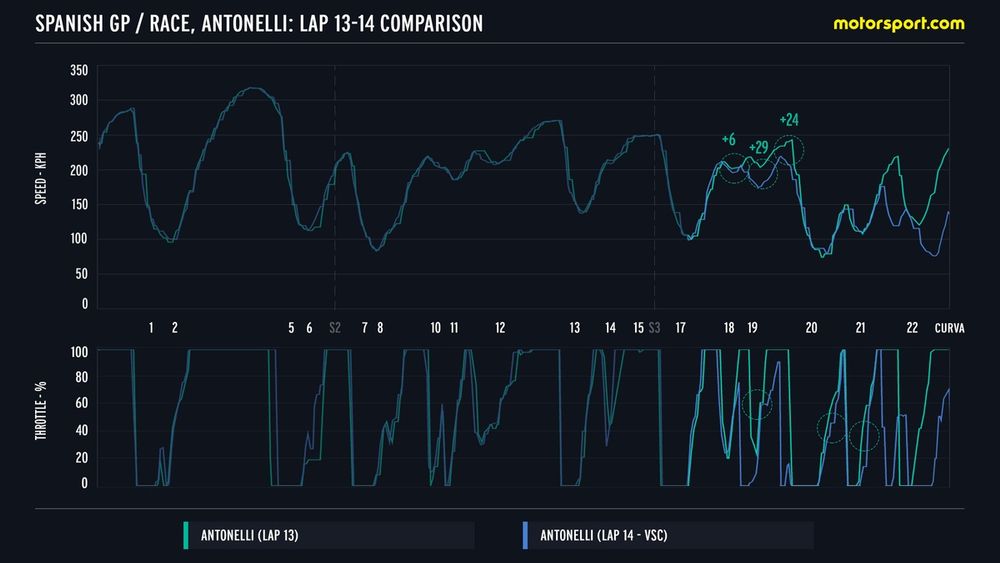
Comparison of Kimi Antonelli’s telemetry data
This becomes even clearer when comparing the data from lap 14 with lap 13, before the VSC was deployed. Once the yellow flag was shown, Antonelli went through Turn 19 29km/h slower than on the previous lap. He then reached the braking zone for Turn 20, where Stroll’s car had come to a stop, 24km/h slower, having lifted off much earlier.
The goal was to maximise the chance of making a pitstop under the neutralisation, and not just satisfy the regulations, which require drivers to slow down under yellows.
To understand just how much the Italian deliberately slowed down beyond what was required, it is useful to compare his telemetry with Max Verstappen’s from the same lap, with the Dutchman running six seconds behind him.
Under the same yellow-flag conditions, before the VSC was deployed, Verstappen was 15km/h faster than Antonelli through Turn 19 and reached the braking point for Turn 20 18km/h quicker, lifting later than the Italian.
But Antonelli’s actions were only one part of the process. The Mercedes pitwall had already anticipated that a VSC was likely, allowing the team and driver to react immediately if race control neutralised the race.
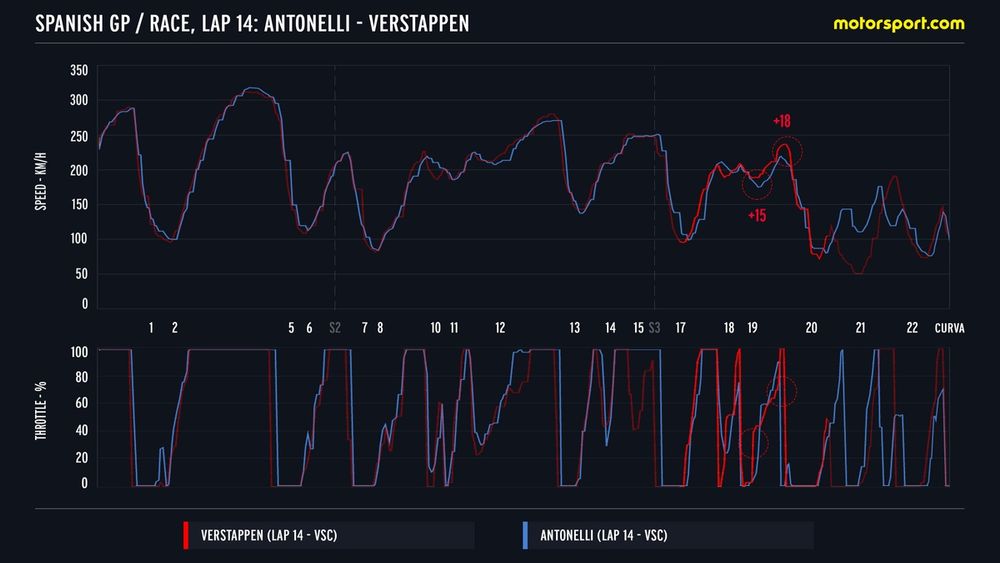
Kimi Antonelli’s telemetry compared to Max Verstappen’s
“In my case, the timing was perfect: Bono warned me in the final sector that a virtual safety car might come out, so I lifted off,” Antonelli said after the race. “I slowed down a bit on purpose to see if I could catch the VSC right before the pit entry, and it worked out great.”
As Antonelli explained, his race engineer alerted him that a VSC might be deployed even before race control officially activated it, because the pitwall’s real-time analysis suggested a neutralisation was highly likely.
That prompted Antonelli to back off further, giving both himself and the pitwall more time to react if the VSC was called.
As soon as he saw the VSC signal, Antonelli dived into the pitlane.
Mercedes team principal Toto Wolff highlighted how quickly the information had travelled from the strategy team to Antonelli, saying the entire process had taken around three seconds.
“The chain of command, the process was great,” Wolff said.
“The strategy group had it on their mind, obviously, and then someone said, ‘That’s not going to clear quickly with the Aston Martin in the wall’. And then it was strategy to Bono, Bono double-checked, Bono to Kimi, and that was all. We’re talking about three seconds.”

Andrea Kimi Antonelli, Mercedes
Photo by: James Sutton / LAT Images via Getty Images
It’s impossible to tell whether Antonelli’s own actions made the difference in this case, yet it could well serve as another example of his ability to read the race. The VSC timing certainly played in his hands, but giving himself and the team additional extra tenths of seconds to make the right call by lifting off in anticipation of VSC may well have earned him the race win.
We want your opinion!
What would you like to see on Motorsport.com?
– The Motorsport.com Team