19 Years Later, One of the Best Crime Movies of All Time Is Officially Streaming for Free
Films about serial killers tend to focus on when and how their murders occur, most often in explicit detail. The crimes are then followed by the dogged pursuit of said killer by the forces of justice, with a crowd-pleasing finale that sees the fiend face final judgment. Unless they wear a hockey mask, that is. That said, what, then, is a film about a serial killer that isn’t about the serial killer at all, and provides no closure? Only one of the best crime movies of all time: Zodiac. It’s a true-life crime movie built around the Zodiac killings that plagued the San Francisco area in the 1960s/70s, and it’s streaming for free on Pluto.
The Hunt for an Elusive Serial Killer Becomes an Obsession in ‘Zodiac’

The film opens with Darlene Ferrin (Ciara Moriarty) and Mike Mageau (Lee Norris) making a pit stop at a lover’s lane in Vallejo, California, when an unknown man shoots them multiple times with a handgun. Mageau survives the encounter; Ferrin, tragically, does not. It’s a classic example of bait-and-switch, with the film promising to be a gratuitous rundown of the Zodiac’s “greatest hits,” if you will, before it goes in an unprecedented direction. It instead shifts focus to those that the killer taunts with a series of phone calls and coded messages, beginning with an encrypted letter sent to the San Francisco Chronicle calling for the message to be published in the newspaper — if not, they’ve signed the death warrant for a dozen people.
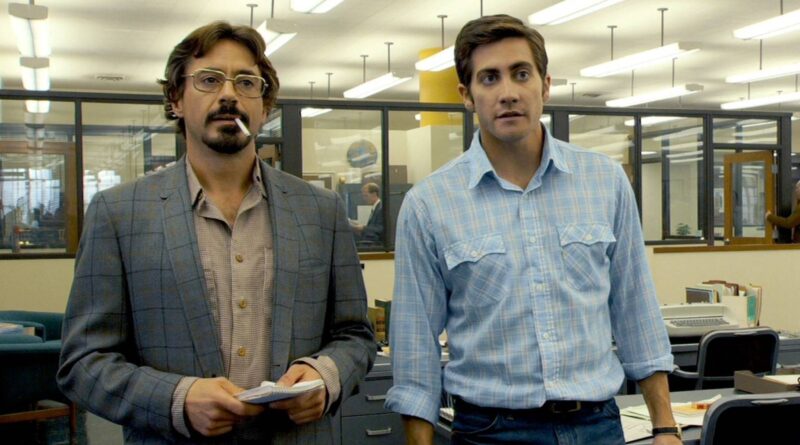
The killer, who calls himself “Zodiac,” says that the message contains his identity, but political cartoonist Robert Graysmith (Jake Gyllenhaal) asserts that it does not. The assertion is played down by the newspaper editors and by crime reporter Paul Avery (Robert Downey Jr.), only for Graysmith to be proven right after the message is deciphered by an unnamed couple. Meanwhile, the Zodiac takes another two lives in Napa County (the second of only three murders seen on screen). Following the deaths, Avery invites Graysmith into the fray, finding his insights to be helpful.
The killing of a taxi driver on October 11, 1969, sees police inspectors Dave Toschi (Mark Ruffalo) and Bill Armstrong (Anthony Edwards) assigned to the case. Yet, time after time, the Zodiac evades capture, with every lead, every theory consistently dashed, including their prime suspect, Arthur Leigh Allen (John Carroll Lynch), who is scratched off the list after a handwriting expert reveals that Allen didn’t write the Zodiac letters. The elusiveness of the Zodiac killer takes its toll: Avery turns to drugs and alcohol after receiving threats, Armstrong transfers to a different division, Toschi is demoted after being accused of forging one of the Zodiac letters, and Graysmith loses everything — his job, his wife, Melanie (Chloë Sevigny), and the kids — when his obsession with finding the Zodiac consumes him.
‘Zodiac’ Is an Undisputed Masterpiece
In real life, the Zodiac case remains open, with the killer having never been caught; it’s not a spoiler, but rather a fact that colors the film as a whole. Going in, we know the bravado of those pursuing the Zodiac, with their eagerness to bring him to justice, will fall away, so the movie is less about the killer and more about how the persistent futility, dead-ends and threats weigh on the players involved. It’s about how the gradual erosion of confidence wears away, manifesting in different, equally-debilitating ways.
And it works because director David Fincher allows it to happen. He resists the urge to shortcut the investigation, instead giving the viewer insight into the accuracy of the investigation: the starts, the stops, the theories that go nowhere. It’s one thing to have your only suspect cleared, and quite another to see the work that went into corralling the suspect in the first place, only then to have the suspect cleared. It’s a slight but subtle difference that sets Zodiac apart from its kin. That, and the deft use of camera angles and close-ups that accentuate the taut nature of the environment.
And that, in turn, only works thanks to the embarrassment of riches Fincher has with his cast. Downey, as usual, is lights-out, bringing a cocky, untouchability to his character that gets challenged before simply falling apart, appearing more and more unkempt as time progresses. But he’s not alone, with everyone in the cast rising up to the challenge of bringing a believability to their real-life characters. They all sell the gradual breakdown of their psyches, forging a natural pathway to where they end up. Gyllenhaal, for one, slowly builds his character from having a fascination with the Zodiac to a full-blown obsession without resorting to cheap theatrics to sell it.
Zodiac is highly accurate, too, but does have one inherent flaw: Graysmith’s bias. As it is based on Graysmith’s two books about the case, Zodiac and Zodiac Unmasked, the film follows the narrative that Graysmith follows, which, while definitely accurate, skews toward Graysmith’s assertion that Allen was the killer. As a result, the back half of the film builds up the evidence that had Graysmith convinced of Allen’s guilt in the first place, to the exclusion of other high-profile suspects (or any of the 2,500 in all, for that matter). In fairness, it would have been difficult to build a case around multiple suspects and still fit it into the movie’s running time, so it’s a minor, forgivable aspect. Zodiac is one of the best crime movies of all time, and it would be a crime not to check it out, for free, on Pluto.